The Drake Crossing: The Raw Power of the Southern Ocean
When Christian finished speaking, the lecture theater went quiet. Most people were already thinking about connections to rebook and itineraries to unravel. I was thinking about the Drake Passage, and how long I had wanted to cross it.
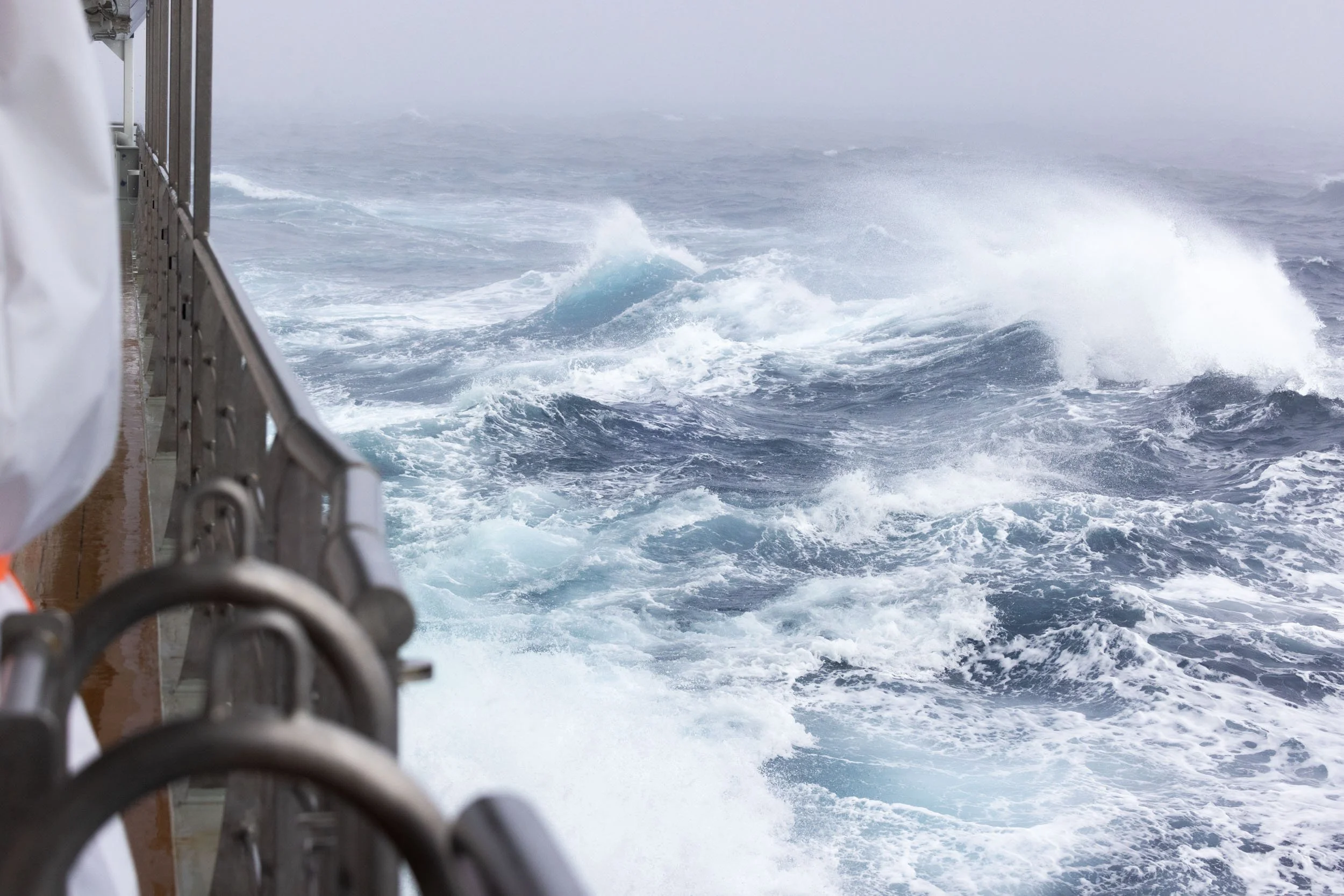
Treacherous winds and seas while Crossing the Drake Passage in February 2024. © Greg Purnell
I grew up in and around boats. Not big ships, but small ones, the kind where you feel every wave and learn early that the ocean doesn't particularly care about your schedule or your comfort. The Drake Passage was something else entirely. I knew it from childhood, from National Geographic documentaries that made it look like the edge of the world: the stretch of open water between Cape Horn and the Antarctic Peninsula, roughly 500 miles of the Southern Ocean with nothing to interrupt the wind as it circles the globe. The roughest seas on the planet, by most accounts, and with good reason: that narrow gap funnels the storms that circle the Southern Ocean with nothing to slow them down, and ships had been lost there for centuries. It looked terrifying because it was.
On February 25th, Christian, our expedition leader, gathered us in the lecture theater to deliver the forecast: the weather over King George Island was going to make flights impossible for the next several days, with little certainty about when that would change. The call was made to sail north instead. The Sylvia Earle would cross the Drake Passage to Puerto Williams, Chile, where a charter flight would carry us to Punta Arenas. The room absorbed it quietly: most people had connections to rebook, itineraries to unravel, the particular headache of international travel going sideways from one of the most remote places on earth.
For me, it was good news. Crossing the Drake Passage was something I had wanted since childhood, and it had just landed in my lap without my having planned for it. The ship was Drake-proofed before we left: belongings secured, loose items stowed, and sick bags placed at intervals along the railings throughout the public areas. A thoughtful signal of what was to come.
The Drake as we started our crossing from Antarctica to South America. © Greg Purnell
The Crossing Begins
The swells built gradually on the first day, reaching somewhere between four and six meters by the time we were fully into the passage. To give you a sense of what four to six meters looks like from a ship deck: the horizon disappears. You are in a valley of water, and then you are on a ridge of water, and then you are in a valley again, and the ship is doing all of this continuously and simultaneously in multiple axes at once. The motion is not unpleasant, exactly, but it is relentless and it is not optional.
Many of my fellow expeditioners retreated to their cabins for the duration. I was fortunate that the motion didn't bother me, which meant I could do what I had come to the lower outer decks to do: photograph.
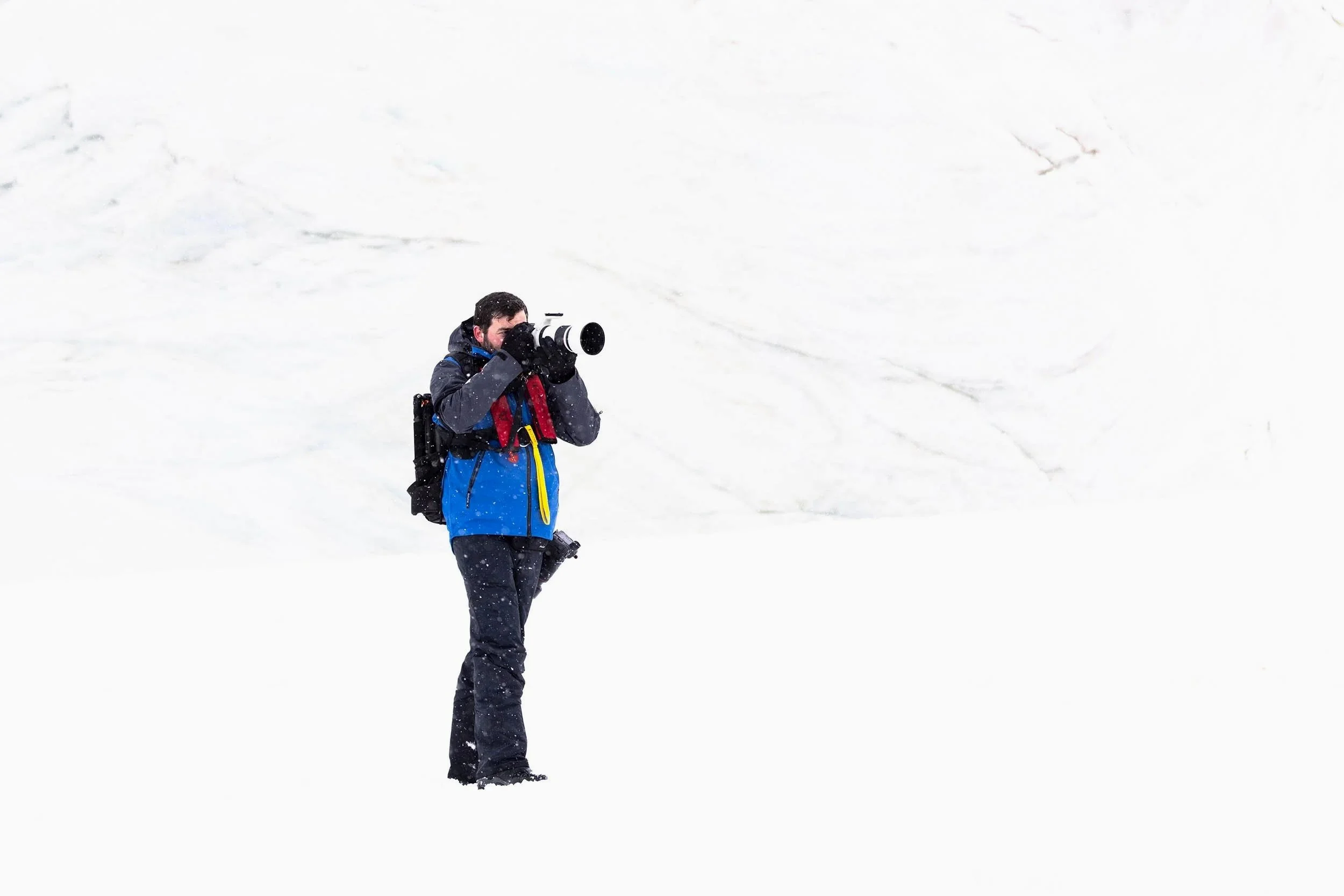
Before the crew closed the outer decks for obvious safety reasons, I managed to squeeze in about an hour of shooting time. Both cameras were strapped to my body, and I sat facing the railing rather than standing (it wasn't a realistic option) and shot through the bars. The challenge of photographing in those conditions is less about settings than it is about timing: the ship is moving, the subject is moving, and the relationship between them is changing faster than you can consciously track. You learn to anticipate rather than react. You watch the rhythm of the swells, find the repeating pattern in the chaos, and commit to a moment before it arrives rather than trying to catch it as it passes. (The Zodiac Dance post covers the moving platform problem in its broader form, and the Drake is that same challenge with the difficulty dial turned considerably further clockwise.)
That’s me spotting Cape Petrels from the deck of the Sylvia Earle while we start the Drake crossing. Photo courtesy Paul Ogle Jr.
These beautiful birds have a distinctive spotted coloring which makes them easy to identify. © Greg Purnell
A trio of cape petrels navigate the Drake. © Greg Purnell
The Cape Petrels
The Cape Petrels arrived.
A flock of them appeared alongside the ship, and what they were doing stopped me entirely. They were not struggling with the conditions. They were not simply enduring them. They were playing: flying along the crests of the swells, riding the air that swept up and over each wave as it passed beneath them, surfing the wind in a way that looked effortless and, honestly, looked like fun. While I was sitting on the deck with both hands on my cameras trying not to slide sideways, these birds were treating the same seas as a playground.
A cape petrel flys waiting for the right wave to come along. © Greg Purnell
I took a full collection of shots of them over that hour. The light was working with me: flat and diffuse in the way of overcast Southern Ocean days, which is actually favorable for bird photography because it removes the problem of harsh shadows and blown highlights and lets you expose for the subject rather than the sky. The technical challenge was shutter speed: fast enough to freeze the wingbeats, which meant pushing the ISO higher than I would have liked in that light, but the alternative was motion blur on a moving subject from a moving platform, and that is not a recoverable situation. The shots that worked were the ones where I had anticipated the bird's position relative to a wave crest and been in the right place in the frame to meet it. The ones that didn't work were the ones where I was still tracking rather than leading.
What I kept coming back to, shooting and reviewing and shooting again, was the contrast. The conditions that were pinning me to the deck, that had driven half the ship to their cabins, were the conditions these birds were built for. They were not visitors here. This was home, and they moved through it accordingly (with a kind of authority that made everything I was doing feel provisional by comparison).
Three cape petrels weave through the waves and ride the wind. © Greg Purnell
The Bridge
On the second day, the ship offered a bridge tour, and I took it.
For anyone who hasn't been on a modern vessel: there is no ship's wheel on the bridge of the Sylvia Earle, no large wooden helm, no spoked wheel that a captain grips dramatically while the seas rage. What there is instead is a console of small knobs and levers, precise and purposeful, the controls of a ship that has very little interest in looking the way ships look in movies. A working instrument panel, not a prop. Two officers stood at the windows on watch, monitoring the controls and the water ahead with the attentiveness of people for whom this is a routine Thursday, which for them it essentially was.
Our trusty Captain showing us the bridge. © Greg Purnell
Officers of the watch monitoring the ship as we cross the Drake Passage. © Greg Purnell
The Captain addressed our group and walked us through what we were experiencing (four to six meters, he confirmed, a walk in the park) and explained that the ship had seen swells of ten to twelve meters in these waters, which put our conditions into a perspective I found useful rather than alarming. The Sylvia Earle was nowhere near its limits. The ship was doing exactly what it was built to do, operated by people who had done this many times before and would do it many times again.
The crew's composure made sense once you understood the context: the bridge operates on rotating shifts around the clock, the Captain had seen swells twice this size, and the Sylvia Earle was built for exactly this. Their calm was not performance. It was experience.
It didn’t take long for my lens (and me) to be completely covered in spray. © Greg Purnell
Darkness at Six
On the third morning I woke at six and the cabin was dark.
For the previous two weeks in Antarctica, the sun had barely set: the polar summer light lasted so long that darkness felt theoretical rather than real, something that happened elsewhere to other people. Sunrise had bled into midday had bled into a sunset that lasted hours. I had stopped thinking about darkness as something the day contained.
And now, having moved far enough north over two and a half days of sailing, the sun was only just climbing above the horizon at six in the morning. Real darkness. The ordinary kind, the kind that the rest of the world experiences as a matter of course and that I had forgotten about entirely.
This is how Antarctica leaves you. Not dramatically, not with a final landing, not with a ceremony or a view you know to be the last one. It leaves in the small return of ordinary things: darkness at six in the morning, the planet tilting back toward the familiar. I stood at the porthole for a while before going up on deck. It felt like the end of something I hadn't known was ending while it was still happening.
The sunrise over the Beagle Channel. © Greg Purnell
From the deck, I watched the Sylvia Earle navigate into the Beagle Channel, and the waves stopped. Not gradually — immediately. The channel offered complete protection from the Southern Ocean weather, and the transition was total: one moment we were in the swells of the Drake, and the next we were in calm, protected water with the mountains of Tierra del Fuego on either side. The visual register changed entirely. After two weeks of ice and open ocean, there were green slopes, rocky peaks, low cloud sitting on the ridgeline. After two weeks of ice, it looked startlingly green.
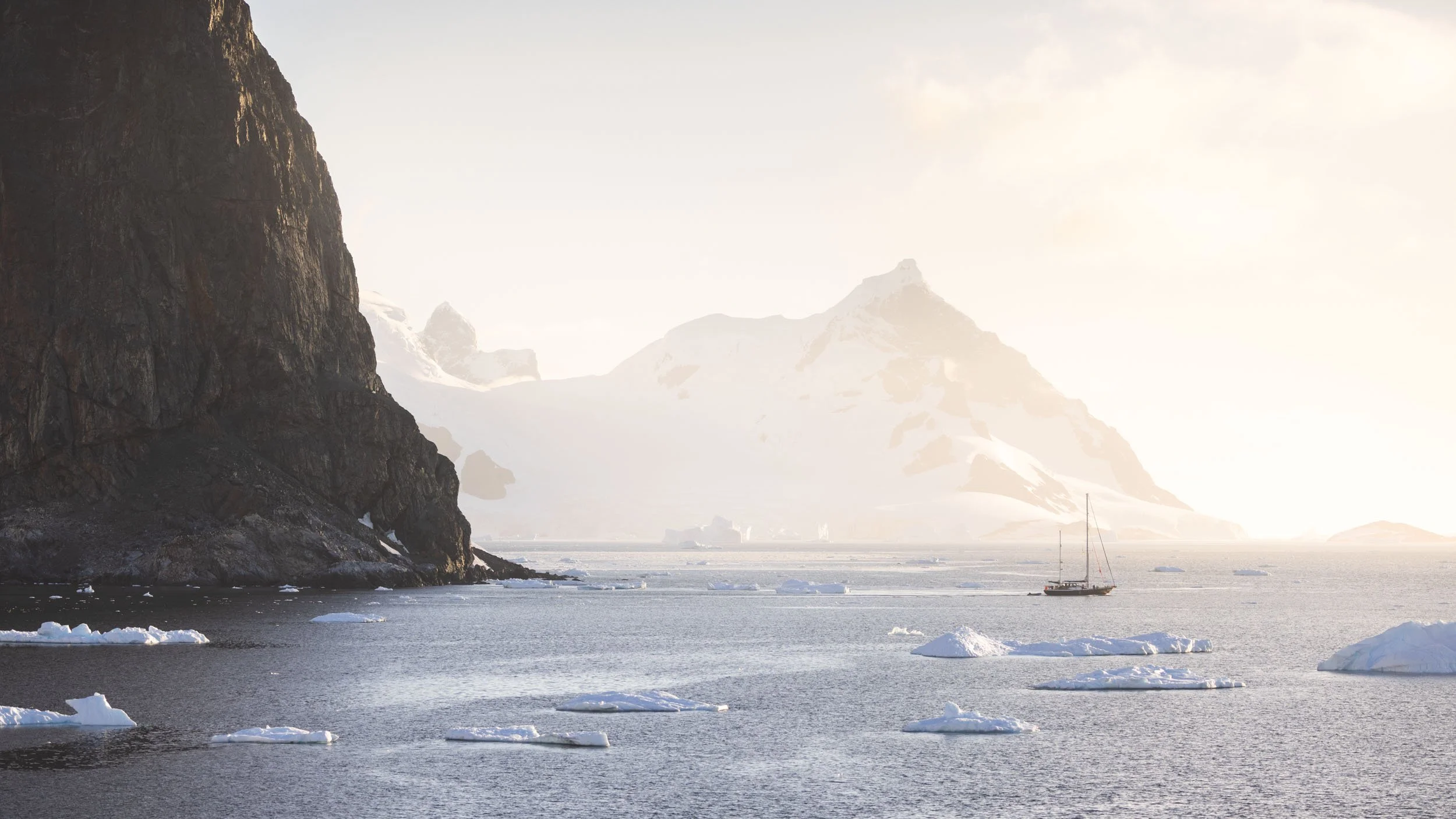
The light on the water that morning was worth photographing: soft and directional, the kind of early-morning quality that arrives before the sky fully commits to the day. The channel framed it differently than any Antarctic location had: narrower, more enclosed, the mountains giving the light somewhere to come from and somewhere to land. I stayed on deck until Puerto Williams appeared on the horizon.
We arrived in Puerto Williams to something unfamiliar—darkness. © Greg Purnell
Puerto Williams
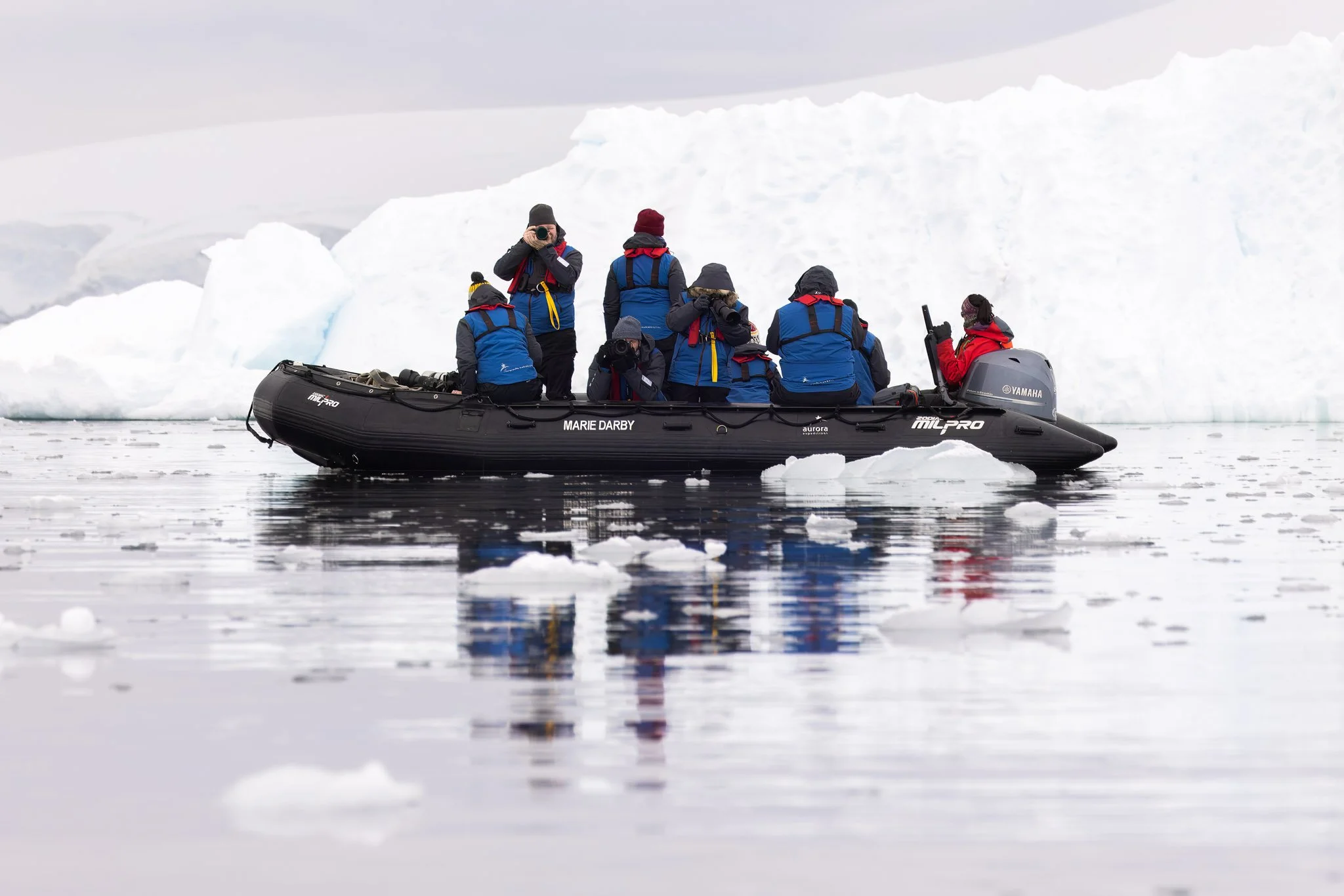
We disembarked by zodiac for the last time.
On shore, we said our goodbyes to the E Team and the Aurora crew: the guides and researchers and ship staff who had spent two weeks making sure we were safe, informed, and pointed in the right direction when we had no idea which direction that was. The farewell happened in pieces, the way expedition farewells always do: a conversation that ends before you've said everything.
We said goodbye to the Sylvia Earle in Puerto Williams, Chile. © Greg Purnell
I wish I had more time to wander Puerto Williams. © Greg Purnell
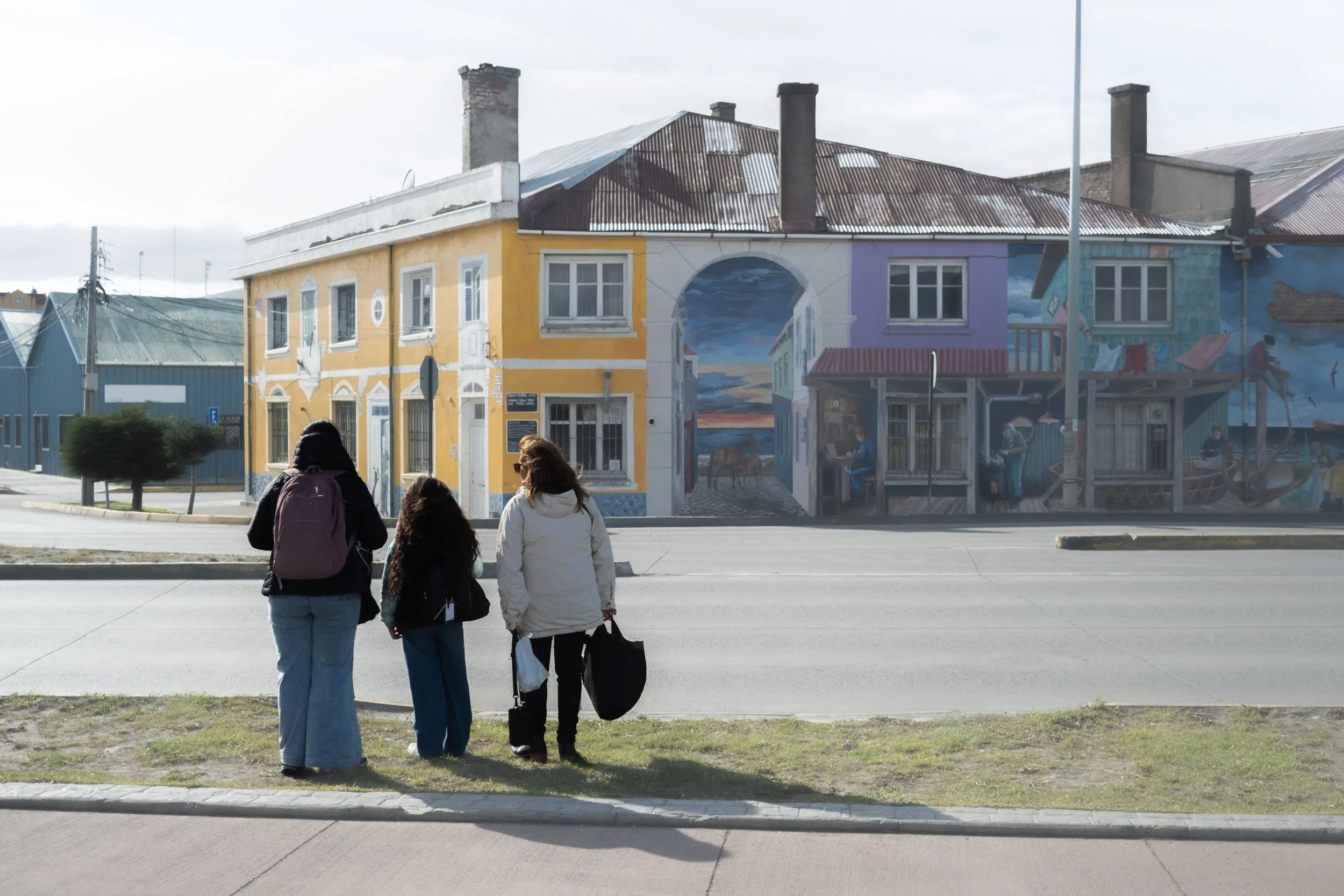
The buses to the airport weren't immediately available, which gave James Popsys, Rick Bebbington, and me about thirty minutes and a port town we hadn't planned to be in. We did what photographers do with thirty minutes and an unplanned location: we walked. Puerto Williams is a small town with fishing boats in the harbor and the kind of streets that reward looking rather than planning. I photographed the boats. I photographed a man crossing between a building and a lamppost in a crosswalk. After Antarctica, a man crossing a street is a subject. It occurred to me later that the trip had opened the same way: a photo walk in Punta Arenas while waiting for a bus. Different city, different people, different eye, but the same instinct.
The mountains behind the port were still there when we boarded, filling the window of the bus on the way to the airport. We flew to Punta Arenas.
What came next is a story for another post: a complete repack, friends already two days into the W-trek without me, a bus to meet them somewhere in the middle of Patagonia.
Thank you to the Cape Petrels for sharing the Drake with me. © Greg Purnell
Final Thoughts
The Cape Petrels are the image I come back to most from the Drake crossing. Not the swells, not the ship's motion, not the darkness on Day 3. The birds. What they were doing in those conditions was not a demonstration of indifference to difficulty. It was something closer to fluency: a complete ease with an environment that had been built into them over a very long time. I think about that distinction sometimes when a shoot isn't going the way I wanted, when the conditions are working against me and the results are showing it. The Cape Petrels weren't ignoring the Drake. They were reading it: finding the lift in each wave, riding the air that the swell made available, turning the obstacle into the vehicle. I don't know that photographers get to fluency in quite that way. But the Cape Petrels suggest what it might look like when something does.
— Greg
Coming next: a different kind of seeing. On training the eye to find geometric composition in environments that aren't designed to produce it.