Birds and Bergs
There is a photograph I didn't take. The berg was there. The bird was there. I was there, in the zodiac, with the camera up. The problem, as it so often is in Antarctica, was sequence.
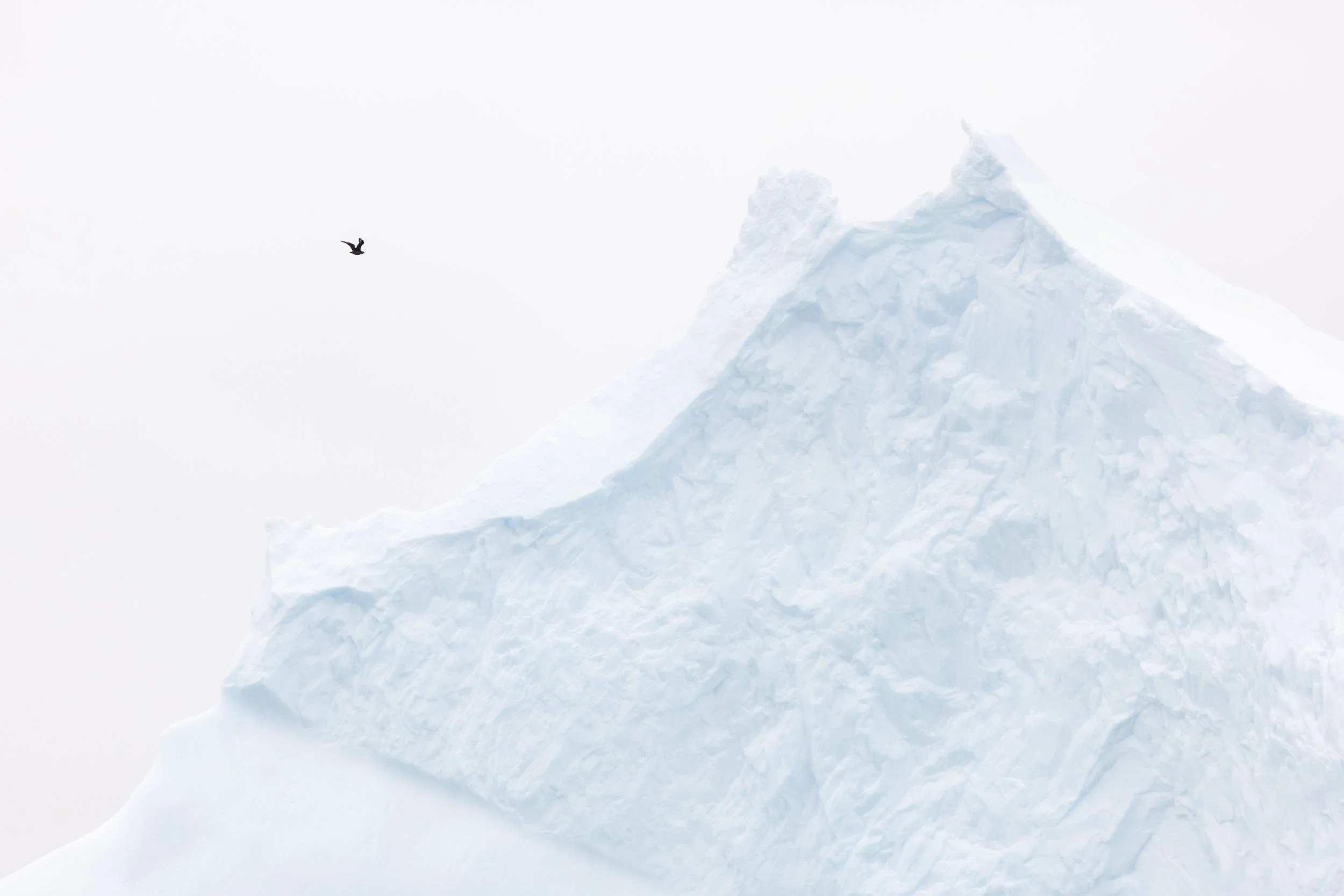
I love the clean minimalist composition of a single bird flying near the low contrast form of a berg. © Greg Purnell
From a zodiac, the geometry of the thing becomes very clear very quickly. You are low on the water, which means the iceberg rises above you at an angle that flattens the horizon behind it into a band, and if the sky is doing what you need it to do (which is to say, not much), the berg and the sky merge into a single tonal field, ice above water and soft grey above that, the boundary between them almost arbitrary. This is the condition you're after. The overcast days that other photographers complained about on the ship were the days I wanted to be on the water. The grey sky isn't a consolation. It's the composition.
What you're building, when you find that iceberg against that sky, is a void. A clean, nearly featureless plane that will make any bird that crosses it legible as pure form. The shape of the wing. The direction of the flight. Nothing else.
An Antarctic tern in flight. Shot from a zodiac while secretly hoping it would fly near an iceberg. © Greg Purnell
The Antarctic Tern flew near an iceberg, as desired. © Greg Purnell
The technique is simple to describe and tedious to execute. You find your berg, you frame it, you lock the exposure, and then you wait. The birds around the Antarctic Peninsula (petrels, gulls, shags, skuas, any of them) are flying fast and on their own business, so you don't compose on the bird. You compose on the ice, and you wait for the bird to enter the frame. When it does, you shoot. Whether you got anything useful, you find out later.
The failure modes are numerous. The bird enters at the wrong point in the frame (too high, too low, clipped at the edge) and the geometry doesn't resolve. Or the timing is off by a fraction and the shutter catches a wing in the wrong position, folded or raised in a way that reads as awkward rather than clean. Or the bird is moving so fast through a narrow window of acceptable sky that you fire a burst and every frame has it in a slightly wrong place. You miss it. You wait for the next one. Antarctica has no shortage of birds.
These two birds in silhouette by the sky are dwarfed by the massive scale of this particular berg. © Greg Purnell
What you're actually doing, across all of this, is less like photography and more like a kind of geometric editing in real time: deciding, as each bird crosses, whether what the world has offered you is the image or isn't. Most of the time it isn't. A few times per morning it is close. Very occasionally, the pieces align in a way that feels less like luck and more like the iceberg had a plan.
The photograph I keep coming back to from these sessions is of a kelp gull. It is crossing the face of a berg from left to right and angling upward, and the berg below it has a sweeping curved line that rises in the same general direction as the gull's flight path. The line in the ice doesn't point at the bird. It continues into the bird. As if the gull was released from the ice, or is in the process of becoming it. The grey sky holds everything flat and still. The image has four elements: white, grey, the line, and the bird. It is the closest I got, in ten days on the Peninsula, to the photograph I had in mind from the first morning on the zodiac.
I loved the form of this berg, and waited for a bird to fly into frame. This composition is unbalanced to me, due to the weight and directionality of the berg. © Greg Purnell
This is the same bird, mere milliseconds later. It flew past the berg and I happened to capture it in a position that is much more balanced and pleasing. © Greg Purnell
Ok, you got me. This one isn’t a berg, it’s a bit it ice and rock, but I loved the simplicity of the lines, along with the pair of birds in flight which balance out the frame. © Greg Purnell
The patience isn't a virtue, exactly. It's a method. You can't rush a bird into the frame at the right moment with the right wing position on the right part of the ice. You can only be ready when it happens, and sanguine when it doesn't, and clear-eyed enough to recognize the difference between a good enough and the one. The kelp gull was the one. Everything before it was practice.
— Greg