

The Zodiac Dance: Shooting from a Moving Platform
The humpback surfaced about twenty feet from my zodiac at Skontorp Cove, close enough that I could hear the breath before I registered what was happening. The guides cut the engines immediately (standard protocol when a whale surfaces that near), and for a moment the only sounds were water and the low exhale of something very large and completely unbothered by our presence.
It can get crowded shooting on a zodiac. © Greg Purnell
I had the 100-500mm up and got the fluke, full frame, water streaming off the trailing edge. Then I realized I was at 100mm and still running out of room. The whale was too close for a long lens. I put it down and grabbed the 24-70mm, and got something closer to what the moment actually felt like: an animal the size of a bus, three feet of water between it and the neighboring zodiac, entirely on its own schedule. It dove, came up on the other side of the second boat, surfaced again, spouted, and then was gone. The whole encounter was under a minute.
That's what a zodiac does. It takes you off the ship and puts you in the place where things actually happen: at water level, inside the environment rather than above it, close enough that your long lens is sometimes the wrong tool. What it asks in return is that you let go of a certain kind of control, because out here the animal sets the terms, the water sets the terms, and your job is to be ready when something happens.
Two Feet of Personal Space
The zodiacs deployed from the Sylvia Earle are Zodiac-brand MilPro inflatables, launched by crane from the ship's side and driven by a Yamaha 60hp outboard. Each one is named after an expedition hero; ours included the Louise Arner Boydand the Harriet Williams Russell Strong, among others, and each holds around ten to twelve passengers plus a guide at the stern.
The guide stands. Everyone else sits on the inflated outer tube, perched with roughly two feet of personal space on either side, and gear lives in your lap or on the floor. The engine produces a constant low vibration even at idle, and when the boat is moving across open water, the hull rises and falls with the swell in a rhythm you learn to anticipate. Even when stationary near a subject, the zodiac is never quite still: there's always some small movement, some gentle oscillation, something underneath you that isn't solid ground.
Stepping from the relatively stable Sylvia Earle into the zodiac while it rose and fell against the hull was its own exercise in commitment, with a crew member holding the bow line and the swell doing what swells do. With a bag on your back, cameras at your sides, and four layers of clothing under a lifejacket doing its best to limit your range of motion, keeping one hand free for the helper required actual forethought, and sitting down with everything intact was a relief every time.
Prepare to get wet, especially in the wind and chop. © Greg Purnell
We boarded via the ship’s side shell doors. © Greg Purnell
What to Bring
I ran two Canon R5 bodies on every zodiac outing. This is a personal preference (most photographers on the trip worked with one body, and produced excellent work), and I cover the reasoning in depth in The Cold Expedition Kit. The short version relevant to the zodiac: changing lenses on a moving, crowded inflatable, in cold and wet conditions, while also trying to pay attention to whatever wildlife is nearby, is possible but inadvisable. My preference was to have a 100-500mm mounted on one body and a 24-70mm or 15-35mm on the other, so I could switch between long and wide in the time it takes to put one camera down and pick up another.
The second body spent most of its time on the floor of the zodiac, lens pointed aft toward the engine, away from any spray coming over the bow. Batteries and filters I kept in an outer jacket pocket, accessible without opening any bag, because the zodiac is not a place to rummage. The window for any given opportunity is rarely more than a few seconds wide, and the time you spend opening a zipper is time you're not shooting.
From a distance, this dark ice looks dirty and cloudy, but up close it’s evident that It’s actually the opposite. © Greg Purnell
At Borgen Bay on February 22nd, with no wind and a mirror-flat sea, I had a CPL filter in that pocket. Marcus, the ship's geologist, had explained something the night before that changed how I was thinking about the ice: what looks from a distance like dark, dirty ice is actually the opposite. It's ancient ice, compressed under so much pressure for so long that all the air bubbles have been forced out. Without those bubbles to scatter light, the ice becomes almost completely transparent, and transparent ice sitting in dark water appears nearly black. From fifty feet it looks contaminated. From ten feet, leaning over the floor of the zodiac with the wide lens hanging over the pontoon, you can see that there's nothing in it at all. The CPL cut the surface glare and let the ice read the way it actually looked, which was not like anything I'd expected prior to close inspection.
The other thing you solve before leaving the ship is what you're wearing. Zodiac outings run two to three hours, on open water, in conditions that are going to get you wet regardless of what the weather is doing. Spray comes over the sides when the boat is moving; precipitation comes from above; sitting on an inflated rubber tube in Antarctic air is cold in a way that accumulates. The layering system I used, along with the cleaning ritual I ran after every outing (non-negotiable near salt water), is covered in full in The Cold Expedition Kit. What matters for the zodiac specifically is that warmth and mobility are in direct tension, and you need to have resolved that tension before you board, because you will not be able to solve it once you're out there.
An antarctic fur seal resting on an ice floe in Borgen Bay. © Greg Purnell
The Low-Angle Advantage
Sitting on a rubber tube puts you roughly two to three feet above the waterline, which is already lower than any deck on the Sylvia Earle. But the position that produced the most productive photographs for me was lower still: kneeling on the floor of the zodiac, camera arm resting on the outer pontoon, shooting at or near water level. It's only practical when your subject is on your side of the boat, and it requires a word with the guide before you start moving around, but the angle it produces is unlike anything achievable from a standing or seated position.
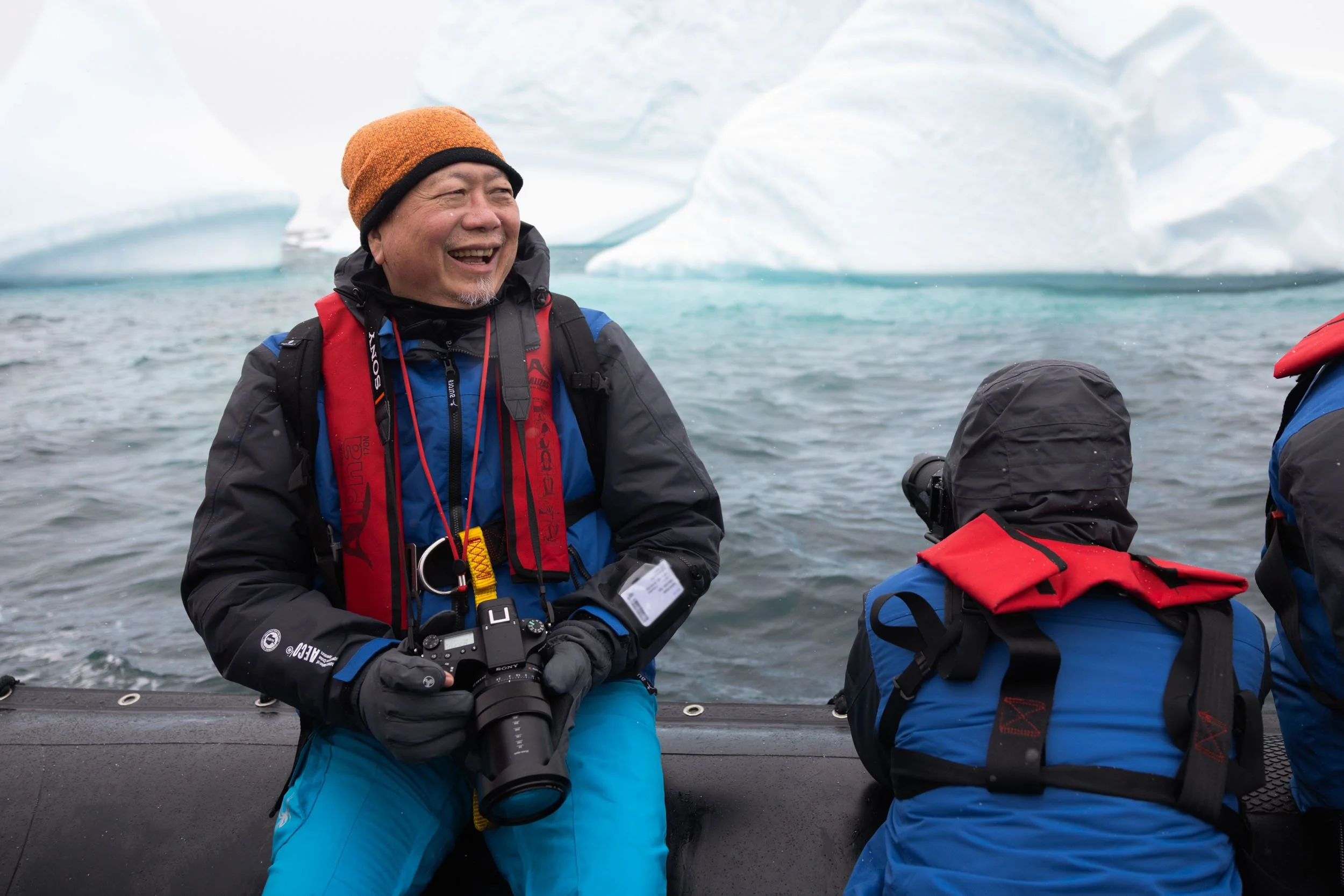
Without a doubt, shooting from a zodiac is a lot of fun. © Greg Purnell
The low angle perspective is great for providing a sense of scale. © Greg Purnell
At Recess Cove on February 19th, shooting icebergs in snowfall and flat grey light, being at water level meant the foreground ocean occupied the bottom of the frame and the ice rose directly out of it, rather than sitting above a horizon line like a postcard. At Cierva Cove on February 23rd, with engines off and the zodiac drifting slowly toward a leopard seal hauled out on a floe, that same position put me roughly eye-level with an animal about 35 feet away. Close enough, at that angle, that the 24-70mm was the right lens and the long lens would have been too tight for the environment. The seal photographs from that session are some of the best wildlife portraits I took on the trip, and they exist entirely because the floor of a zodiac puts you in a place no ship deck ever could.
For the bird photography above Winter Island on February 20th, that low angle gave a cleaner separation against the grey sky. I wrote about those encounters in more detail in Birds and Bergs, but the relevant point here is that the platform, not the lens, is what made the compositions possible.
Shooting from a lower perspective enabled this shot of a Bird and berg against a minimalist sky. © Greg Purnell
Another example of scale doing it’s job. © Greg Purnell
Choosing Your Zodiac
The group divided into separate zodiacs for each outing, with one host photographer assigned to each boat. On this trip, there were eight host photographers and they all have wonderfully different sensibilities and approaches to photography. As a guest, you chose your zodiac, which meant you effectively chose your companion for the session, and I was deliberate about that choice based on conditions.
Smooth water and good reflection potential: I'd find Mads Peter Iversen, because his eye for landscape precision in that kind of light is unmatched. A research station or built structure on the agenda: I'd look for James Popsys, whose approach to human-made environments in wild contexts is one of the more distinctive approaches I've encountered. Whale sightings likely: I tried to position myself in the zodiac with the ship's whale expert, because shooting alongside someone who can tell you what a humpback is about to do next changes what you reach for. (At Skontorp Cove, I was in the right boat. I cannot claim it was entirely by plan.)
There's an honest corollary to this. My experience was also simply shaped by which boat I was in. Different zodiacs went to different parts of the landscape. Sometimes one boat would find something and radio the others, but by the time everyone arrived the perspective had shifted or the animal had moved. Antarctica doesn't distribute its moments evenly. What it does give everyone is a different story, and every story is equally true, just seen through a different eye.
Brown Station near Paradise Harbor. © Greg Purnell
There are endless compositions, even in the fog. © Greg Purnell
Working Inside the Constraint
On land, when a composition isn't working, I move. I walk ten feet left, crouch, find a foreground element, try again. It's a reflex built over years of shooting in environments where I control my own position.
A zodiac with eight other photographers is not that environment.
You can ask the guide to reposition, and the guides on the Sylvia Earle were generous about this, but you're asking on behalf of ten people, not just yourself, and there's a real etiquette around how often and how insistently you make that request. The boat moves as a unit. If the frame you want requires a ten-degree rotation and someone else's shot depends on the current position, you wait, or you find the photograph inside the constraints you have.
What surprised me was how productive that limitation turned out to be. The zodiac goes almost anywhere: through brash ice, around the faces of icebergs, right up to a seal on a floe. The range of positions it covers in a single session is wider than anything achievable on foot. The constraint isn't that the zodiac won't move. It's that it moves on terms negotiated with everyone aboard. Learning to work inside those terms, rather than against them, is where the better photographs came from.
The informal choreography that developed over the week: the guide would often spin the boat when something appeared on one side, so both sides got the same view. Photographers shot through each other constantly, lenses crossing frames, and no one took it personally. When I wanted a specific angle badly enough, I asked. When someone else asked, I made room, and turned the camera on the boat instead. There's no shortage of photographs in a zodiac full of photographers.
Two crabeater seals and a Weddell seal rest on an ice floe near Winter Island. © Greg Purnell
Motion and Missed Frames
The zodiac introduces two sources of motion simultaneously: the platform itself and whatever you're pointing at. The practical response is to treat your shutter speed the way you'd treat it in any other moving situation, and then add a significant margin on top. My rule of thumb was to at least double whatever I'd normally use from land for a given subject, and more for anything fast, unpredictable, or both.
The porpoising gentoos at Skontorp Cove were the hardest subject I attempted on the trip. They surface and dive in a fraction of a second, in no predictable direction, and the zodiac's own movement means your autofocus system is resolving two simultaneous motion problems rather than one. I missed a substantial number of those frames. Not slightly soft. Properly missed, the bird gone before the shutter fired or the AF locked to the wrong thing entirely. Bumping the shutter speed and checking my photographs as I went was the right response, but some subjects are genuinely at the edge of what this platform allows, and pretending otherwise wouldn't be useful to anyone.
Missed it! © Greg Purnell
I missed it again. © Greg Purnell
Finally got it. © Greg Purnell
The custom modes I had set up on both R5 bodies made switching between shooting situations faster: one mode configured for high-speed burst and the fastest shutter speed the light allowed, one for slower and more deliberate work with stationary subjects. Switching between them is a dial rotation, achievable in the time between a whale diving and surfacing again. Setting those modes up before leaving the ship rather than trying to configure them mid-session is not a suggestion. How I configure the R5 for that kind of instinctive switching is worth a post of its own, and I'll write one: custom modes, back button AF, subject tracking, told through real use cases in the field.
I set IS to multi-axis throughout, which is the appropriate choice when motion is arriving from multiple directions simultaneously. And I checked my photographs frequently: front element for spray, focus for accuracy, histogram for exposure. Conditions on a zodiac change faster than you expect, and catching a problem mid-session is categorically better than discovering it on the ship.
Two zodiacs keeping a safe distance from a resting leopard seal. © Greg Purnell
The Wildlife Protocol
When an animal appears near the zodiac, the engine goes off. This is not a suggestion from the guides or a preference of the expedition; it's the operating standard, and it applies regardless of what you were in the middle of photographing when it happened.
The radio system meant that good sightings were shared: when one zodiac found something, the guide would call the others, and boats would rotate through so everyone had a chance at the same encounter from roughly the same distance. At Cierva Cove on February 23rd, two zodiacs circled a leopard seal on a floe for the better part of half an hour, engines barely turning over, boats taking turns drifting close while the seal yawned, stretched, and regarded us with the specific indifference of an apex predator with nothing to prove. The photographs from that session are detailed and close and made possible entirely by the patience the protocol requires.
We were close enough to see the teeth on this incredible beast. © Greg Purnell
The principle is simple: the animal's comfort is the non-negotiable condition. The photograph comes after. What I found, over six days of zodiac sessions, is that this ordering produces better photographs than the alternative would, not despite the constraint, but because of it. A calm animal, habituated to the slow approach of a quiet boat, will give you things a disturbed one never would.
The humpback at Skontorp Cove wasn't a planned encounter and didn't follow the protocol in the usual sense, since the whale came to us rather than the other way around. But the instinct was the same: engines off, quiet, let the animal do what it was going to do. It went under the neighboring zodiac. It surfaced again. It decided we were uninteresting and dove. We didn't direct any of that. We were just there for it.
A humback whale in Skontorp Cove was so close I use a wide angle lens to capture this. © Greg Purnell
In a fleeting moment, this whale gave us a great show. © Greg Purnell
Final Thoughts
The zodiac takes things away. It takes away your tripod, your ability to reposition freely, your lens changes, the stability you rely on for the sharpest frames. It hands all of that authority to the water and the weather and the animals and the eight other people sitting on the same rubber tube. What you're left with is presence: in the place, in the moment, with whatever lens happens to be in your hand when the thing happens.
At Graham Passage on February 23rd, under a clear blue sky, we pulled alongside an iceberg so tall it blocked the mountains behind it. From water level, with the zodiac at its base, the scale is the entire photograph: ice rising out of the frame, a rubber boat beneath it the size of a footnote. That shot doesn't exist from the deck of the Sylvia Earle. It doesn't exist from land. It exists because a rubber inflatable put me thirty feet from something enormous, with no railing between me and the water, and I happened to be ready.
That's what the humpback was, too. Not a planned shot. Not a setup. Just an animal surfacing on its own schedule in a place where I was small enough to notice the difference, and close enough to feel it.
— Greg
Isn’t ice amazing? © Greg Purnell
Coming next: From Antarctica to Africa. I’ll head to Kruger National Park in South Africa in search of the Big Five (elephant, lion, leopard, buffalo, and rhino) and what it actually means to photograph wildlife at that scale, in that light, and from a game vehicle instead of a zodiac.
