Finding the Line: Geometry and the Trained Eye
Geometry is a layer of the world that is always present. It doesn't announce itself. It doesn't wait for you. It is simply there, in every environment you will ever stand in, patient and indifferent, available to any eye that has learned to find it.
Learning that eye is most of what composition is.
Icebergs and bergy bits drifting in Scoresbysund, East Greenland. Sweeping curves, blunt edges, a dark blue abyss. Somewhere in here, there's a composition. © Greg Purnell
The Obvious Version
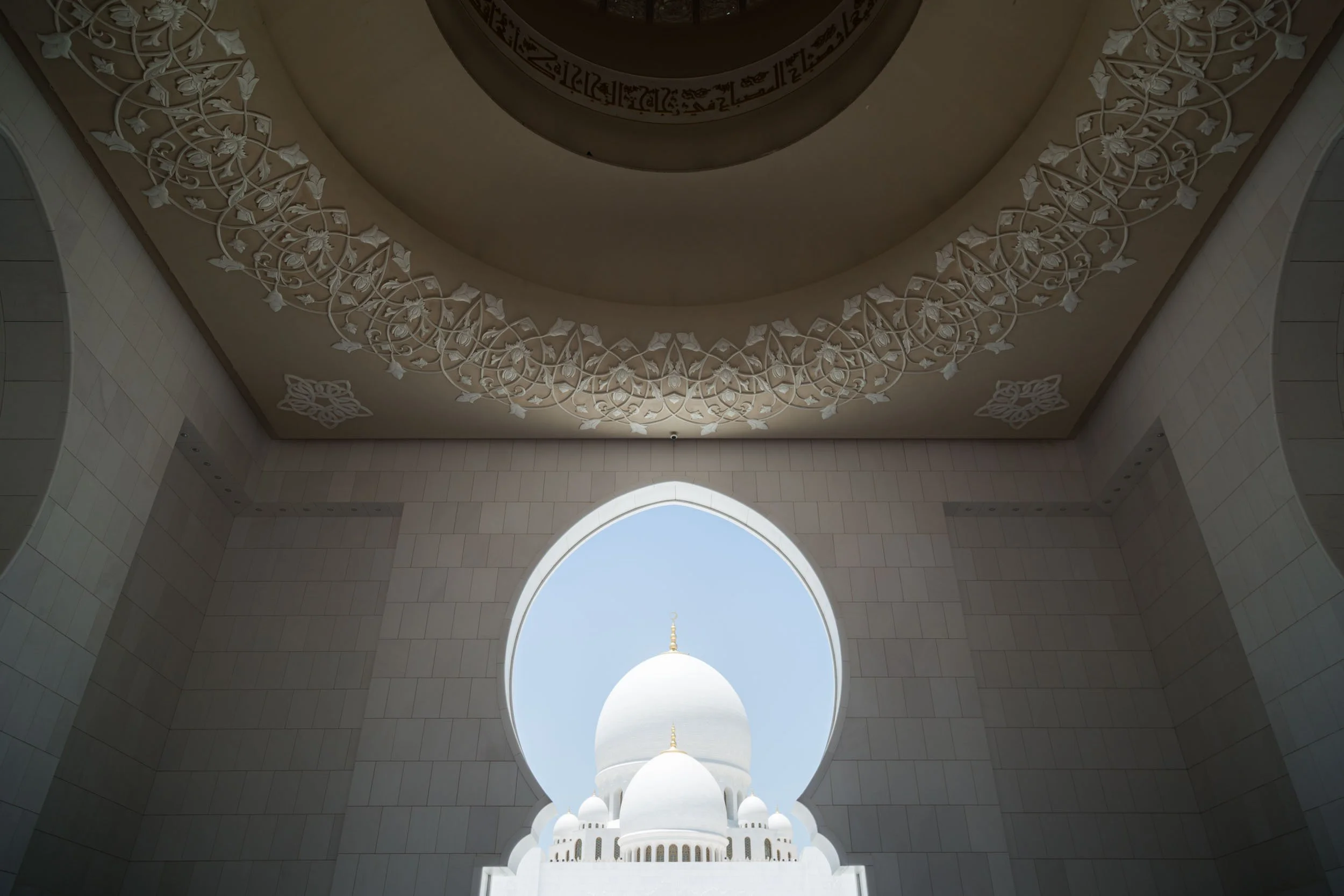
The Sheikh Zayed Grand Mosque in Abu Dhabi is not a subtle place. It was built to produce a specific visual and spiritual experience, and it succeeds at both with an authority that is almost architectural in the mathematical sense. I was there in May 2014, not on assignment (a tourist, visiting a friend, walking through it with no particular intention beyond seeing it). I pulled out my camera (a Canon 6D, at the time) and stood in one spot longer than anyone around me understood.
What stopped me wasn't the scale or the ornamentation, though both are extraordinary. It was something more specific: the near archway framed in my viewfinder was echoing the exact shape of the dome visible through it in the distance. Two structures, the same geometry, one contained within the other. The architecture was asking for alignment, almost demanding it, and placing them in the same frame produced a visual echo that felt less like a compositional choice and more like a discovery. The image works because of that mirroring. The mosque built it in. All I had to do was stand in the right place and notice it.
This is calibration. The mosque is where the eye first learns what a geometric composition feels like: what it means for a frame to resolve into coherent visual logic, for the elements to speak to each other rather than merely coexist, for the geometry to be so present and so intentional that the world appears to be doing the compositional work entirely on your behalf. That's exactly why it's the right place to start: not because the image is easy (though it is), but because the feeling it produces (that sense of a frame clicking into place around a logic that was already there) is the standard the eye will spend years learning to find in environments far less willing to provide it.
The mosque is almost unfairly generous to a photographer. The geometry is everywhere, and it's asking to be found. © Greg Purnell
When the Eye Fires Anyway
In March 2023, I was on a dedicated bird photography trip to Arizona with my friend Alex Grummer, up before dawn and out into the desert looking for species. It was the kind of morning where you're watching the ground and the sky simultaneously and trying not to blink. There was a steel transmission tower in the landscape, the sort of structure you register and dismiss as scenery pollution: a visual intrusion you're already editing out before you've consciously decided to.
I was moving before I'd fully articulated why. A few steps, adjusting angle, until the crow that had landed somewhere in the frame was sitting in the gap between two diagonal cross-braces, isolated against open sky, everything else cleared away.
The geometry in that tower isn't incidental to the image. It's structural, in both senses. The rigid, angular, man-made lines of the cross-bracing meet the organic shape of the bird, and the contrast between those two things is where the visual interest lives. The geometry frames the subject; the subject animates the geometry. The crow perched on clean steel isn't just a bird in a frame; it's a juxtaposition, and the juxtaposition is the story. Neither element works as well on its own.
What the crow shot demonstrates (and what the mosque couldn't, because the mosque makes everything too easy) is what calibration looks like when it fires automatically, in an environment that wasn't cooperating, during a morning when composition wasn't the agenda at all. The eye had learned the feeling in Abu Dhabi and in a hundred places since. In Arizona, it recognized a much quieter version of the same thing, in a structure most people would have walked past without a second thought, while the conscious mind was pointed at the sky looking for birds.
I was there for birds. The crow cooperated. The tower, unexpectedly, cooperated more. © Greg Purnell
Half a Second
Walking on the streets of Seville in May 2023, I passed an ornate archway cast in shadow with warm sunlight coming through the opening. It stopped me there on the sidewalk. A curved walkway swept into the frame from the lower left, and two people were moving up the ramp toward the door, the arch framing them against the light beyond. There wasn't time to set up the shot. I stopped, framed, and captured it before they were gone.
Half a second. No time to adjust, no time to second-guess. This is what readiness looks like when it actually gets tested. © Greg Purnell
If I’m honest, the near archway in this photo isn't perfectly aligned with the distant one. Perfect alignment would have produced a more resolved, more symmetrical composition: the kind of visual echo the mosque delivers so completely. But it would also have made the image feel arranged, and this image wasn't arranged. It was caught. The imperfect alignment is evidence of exactly what this moment was: a half-second of availability, no time to adjust, the geometry appearing and disappearing before I had finished registering it. Whether the slight misalignment costs the image something or gives it something (an honesty, a feeling of genuine capture rather than construction) it up for debate, but in my eyes, it’s true to reality.
The crow required movement to actualize the geometry; Seville required readiness before there was time to move. Both are expressions of the same developed capacity, operating differently under different conditions. The mosque couldn't teach you either of them. It gave you the calibration. What you do with it, under pressure: that's a different lesson entirely.
The Disposition
On a November morning in 2022, passing through Charles de Gaulle on a connection to South Africa, I stopped on the way to passport control and took a photograph on my phone, the only camera I had accessible at the time. The low morning sun was cutting through the terminal windows at a shallow angle, casting diagonal shadows across the windows and columns that turned the whole space into a grid of competing geometry. Most people move through CDG with their heads down, thinking about gates and boarding passes. I couldn't help myself.
The airport adds something new to this progression. The mosque, the tower, the archway in Seville: all of those occurred in contexts where photography was at least on the agenda, where the eye was already oriented toward the world as a source of images. An airport terminal connection is not that context. There is no assignment, no location, no brief. It is a transit space, functional and featureless by design, a place the architecture actively tries to make invisible so you focus on the logistics of moving through it. My eye found the geometry anyway, not because it was asked to look but because it no longer knows how not to. That's a different kind of calibration than the mosque produced. The mosque calibrated the recognition. The years between Abu Dhabi and Charles de Gaulle calibrated the disposition: the state of readiness that operates whether or not readiness was intended.
On my way to passport control. Shot on a phone. The eye doesn't particularly care about either of those things. © Greg Purnell
Structure Is Enough
Between expedition landings aboard the Greg Mortimer in Svalbard in August 2024, with no wildlife in sight and nothing obvious to shoot, I turned the camera on the ship itself. The rails and staircase of the outer deck resolved into a composition of stacked diagonals, lines running parallel and crossing, with a single life ring sitting at the center of the frame.
Diagonals are inherently dynamic. Where a horizontal line reads as stable and a vertical line reads as formal, a diagonal gives the eye a pathway, a direction of travel through the frame. The crossing diagonals of the ship's railing don't just fill the composition; they actively draw the eye toward the center, toward the life ring, which anchors the geometry with a circle and breaks the pattern just enough to hold attention. A static subject in a still scene becomes visually active because the lines around it are doing work.
I was standing on an expedition vessel in the high Arctic and photographing the railing. The expected subject (wildlife, ice, the vast Arctic environment) had temporarily disappeared. What remained was structure, and structure was enough. The trained eye, operating under resourcefulness conditions, finds the image that's available rather than waiting for the image that isn't.
Every line on that ship was put there by a designer. The geometry was human, intentional, embedded in the object. What happens when even that is gone?
No wildlife between landings. So: the railing. When the expected subject disappears, structure is enough. © Greg Purnell
No Architect, No Intention
In the summer of 2025, flying my drone above a field of icebergs and bergy bits in the remote reaches of Scoresbysund, on a sailboat with Jeroen Van Nieuwenhove, days from the nearest settlement, the pieces of ice drifting against the dark water looked like stars from ninety degrees overhead. Not metaphorically: the arrangement was galactic, irregular clusters of bright forms against an absolute darkness, the kind of order that takes your breath away precisely because no one put it there.
I want to be honest about what's different here. A drone changes the nature of the search. On the ground, physical constraints do some of the compositional work for you: your position is limited, your angle of view is narrow, the options narrow themselves. From the air, you can put the camera anywhere, look in any direction, stay as long as the battery allows. The freedom is real, and so is the problem it creates: infinite options and no environmental cue pointing toward any of them. Decision fatigue in a field of icebergs is a genuine photographic challenge, and I'll have more to say about that specifically when the Greenland series arrives. The short version, for now, is this: find the shapes. Find the patterns. Focus in on that, and let everything else fall away.
The eye that recognizes the composition when the viewfinder finally shows it, the chaos organizing itself into apparent order, is the same trained eye from the mosque and the tower and the airport terminal. The search is different. The recognition is the same.
No architect designed this. No photographer organized it. The geometry was there all along, in the drift of a sea of ice in the remote reaches of East Greenland, waiting for an eye that had learned to find it in a building in Abu Dhabi eleven years earlier and had been practicing ever since.
Ninety degrees overhead, days from the nearest settlement. No architect, no intention. The geometry was there anyway. © Greg Purnell
Final Thoughts
The progression runs from a mosque built to produce geometry, to a steel tower that happened to contain it, to an archway that revealed it in passing, to an airport terminal that hid it in plain sight, to a ship railing that offered it as a last resort, to a sea of ice that had it without knowing. What changes across all of them is not the geometry. It was always there. What changes is the cost to the eye of finding it: the degree of work required, the speed of recognition, the conditions under which the trained capacity fires.
The mosque calibrates the eye. Every environment after it is a harder version of the same test. At some point, somewhere between the mosque and the crow and somewhere in the years of looking that run between Abu Dhabi and Arizona, the eye stops needing the world's help. It just finds it.
The crow shot is the proof. I was moving before I knew why. That's not an accident. That's what the training produces.
— Greg
Coming next: shooting from a moving zodiac in Antarctica is its own particular problem: part technique, part physics, part knowing when to stop trying to control the shot.