Punta Arenas: The Last Stop Before Antarctica
The first thing I noticed about Punta Arenas was the wind. Not weather in the polite, variable sense (a physical presence, constant and directional, moving through the streets of a port city at the southern tip of South America as if it had somewhere to be) but something more deliberate than that. I had nearly twenty-four hours of travel behind me, a connection through Santiago, and enough gear for two separate trips distributed across two backpacks and two duffel bags. I was jet-lagged, slightly disoriented, and not yet in Antarctica. I wouldn't be for another three days.
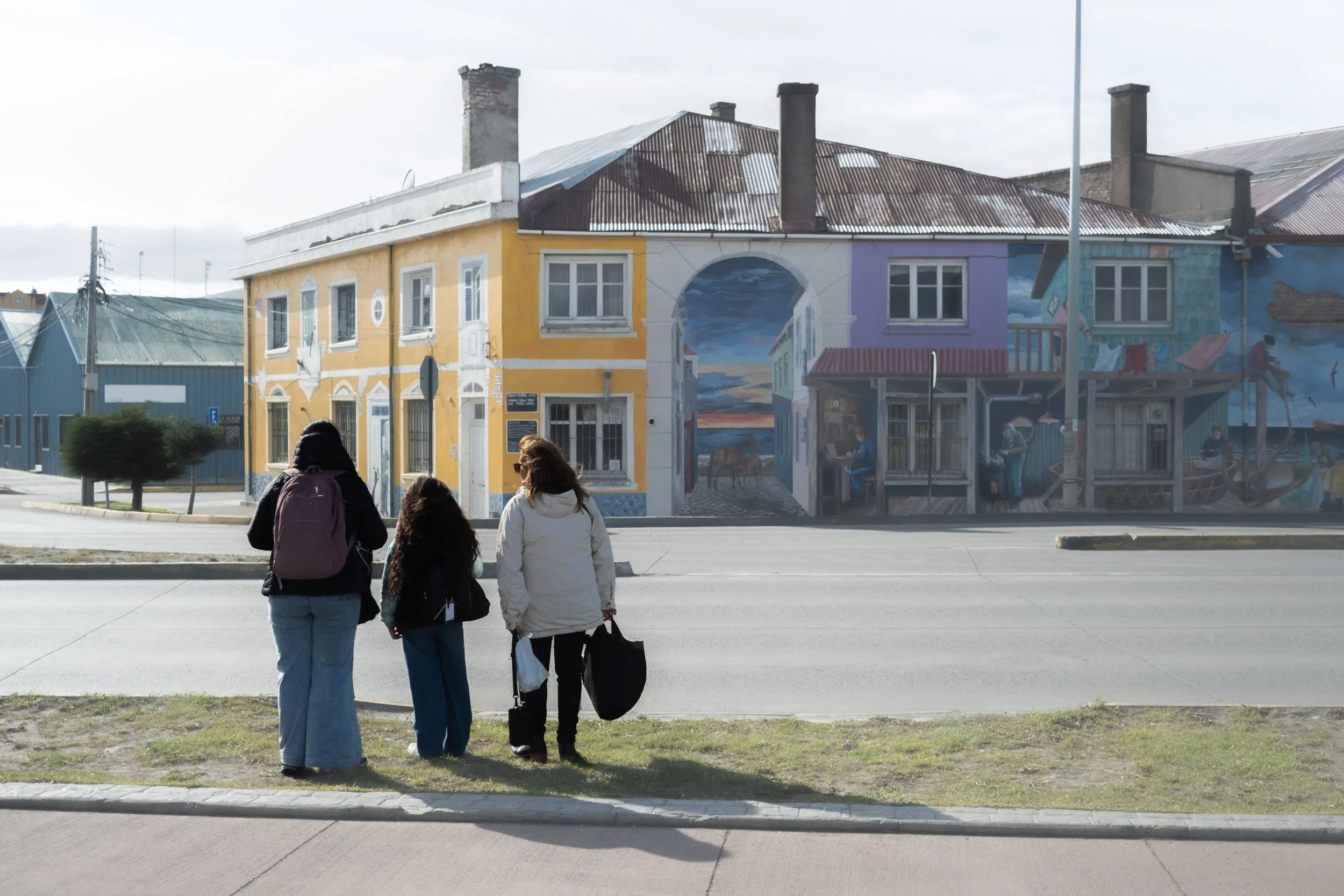
Punta Arenas is surprisingly colorful, and full of street art. © Greg Purnell
Getting to the bottom of the world is not a simple proposition. The flight from Seattle to Punta Arenas, connecting through Santiago, takes the better part of a day, and that's before you account for the layovers, the timezone arithmetic, or the particular challenge of traveling with a full kit of Antarctica expedition gear alongside everything you need for a separate Patagonia trip afterward. By the time I landed in Punta Arenas on the afternoon of February 15th, forward momentum was about all I had left. I found my hotel, unpacked what I needed, and called it a day.
I had arrived deliberately early. The logistics of reaching King George Island (a gravel airstrip on the northern tip of the Antarctic Peninsula, served by charter aircraft, governed entirely by weather) meant that missing the expedition was a genuine possibility, not just a theoretical one. A buffer day wasn't caution for its own sake; it was the minimum sensible margin. What I didn't anticipate was that the buffer would turn into something more than insurance. Punta Arenas had other ideas.
Turns out packing for a photography expedition to Antarctica and a multi-day backpacking trip to Patagonia doesn’t have a lot of overlap. Luckily, I stored the pieces I didn’t need in Punta Arenas and repacked between trips. © Greg Purnell
Punta Arenas can be an interesting subject, if you give it a chance. © Greg Purnell
A City Worth the Stop
The afternoon of February 15th gave me a few hours of light and just enough energy to use them. I walked down to the waterfront, shot along the boardwalk, and wandered by the buildings back toward the hotel. Punta Arenas is not a city that announces itself. It takes a little looking, but what it rewards you with, once you start looking, is color. The murals here are everywhere: large-scale, painted directly onto building facades, vivid against the grey Patagonian sky. Street art in the sense that it has claimed the architecture rather than decorated it. I didn't know what I was going to find when I pointed a camera at this city, but I hadn't expected that.
I liked this little car hiding in the shadows. © Greg Purnell
February 16th was more of the same, unhurried, the city on its own terms. I worked the streets and the waterfront again, drawn back to the murals and the light off the Strait of Magellan. It was the kind of shooting that doesn't produce portfolio work so much as it produces familiarity: a sense of how a place moves, where the light sits at different times of day, which corners are worth revisiting. I was learning the city without particularly intending to. That would matter later.
The group met for the first time that evening, in a conference room at the hotel. Eight photography hosts took to a small stage in turn and introduced themselves: their background, their photographic specialties, what they were there to share. Nigel Danson, James Popsys, Rachel Bigsby, Mads Peter Iversen, Jeroen Van Nieuwenhove, Dani Connor, Adam Gibbs, and Rick Bebbington. The guests introduced themselves too. It was the particular social exercise of a room full of people who are all serious about the same thing and are sizing each other up in the way that serious people do. By the end of the evening, we were a group. Not yet a cohesive one, but a group.
The same evening brought the flight briefing, which clarified what we were actually attempting.
We meet our photographer hosts for the first time in the hotel conference room. From left: Rachel Bigsby, Adam Gibbs, Jeroen Van Nieuwenhove, Dani Connor, Rick Bebbington, Nigel Danson, James Popsys, and Mads Peter Iversen. © Greg Purnell
The Briefing, and What It Revealed
Our destination was TNM: Teniente Rodolfo Marsh Martin Airport on King George Island, a gravel strip adjacent to a small Chilean research base, served by Antarctic Airways on a charter that would operate only when the weather at both ends cooperated. This was not, the hosts made clear, a schedule. It was a target. The group was instructed to keep bags packed and be ready to move at any moment (not as a precaution, but as a genuine operational reality).
Aurora Expeditions, who facilitated the trip, had a representative walk us through what arrival in Antarctica would actually look like: zodiacs would meet us at the beach, luggage would be portered separately, life jackets and provided muck boots were required at all times during transfers. Personal footwear was not permitted: biosecurity protocol, specifically designed to protect Antarctic wildlife from pathogens carried in from outside. Bird flu was spreading globally at the time, and Antarctic bird populations, which have no immunity to it, were considered acutely vulnerable. The weight of that detail didn't fully land until later, when we were on the ground and I understood just how close and how trusting the wildlife actually was.
The safety briefing covered the fundamentals of expedition cruising: no fixed itinerary, conditions-driven decisions made day by day, the E Team and Captain working alongside Nigel and the hosts to determine where we went and when. It was, in the most precise sense of the phrase, an adventure with a plan, and the plan was flexible by design.
An Aurora representative provided a thorough briefing on flight operations, which is extremely weather dependent. © Greg Purnell
Standby
February 17th was our planned departure day, but it didn't turn out that way. Flying into TNM requires a specific convergence of conditions: ice-free approaches, cloud cover above 900 meters, manageable wind speeds, and good visibility. In Antarctica, in February, that combination is rarely a given, and on the 17th it wasn't, so we received updates every hour and waited.
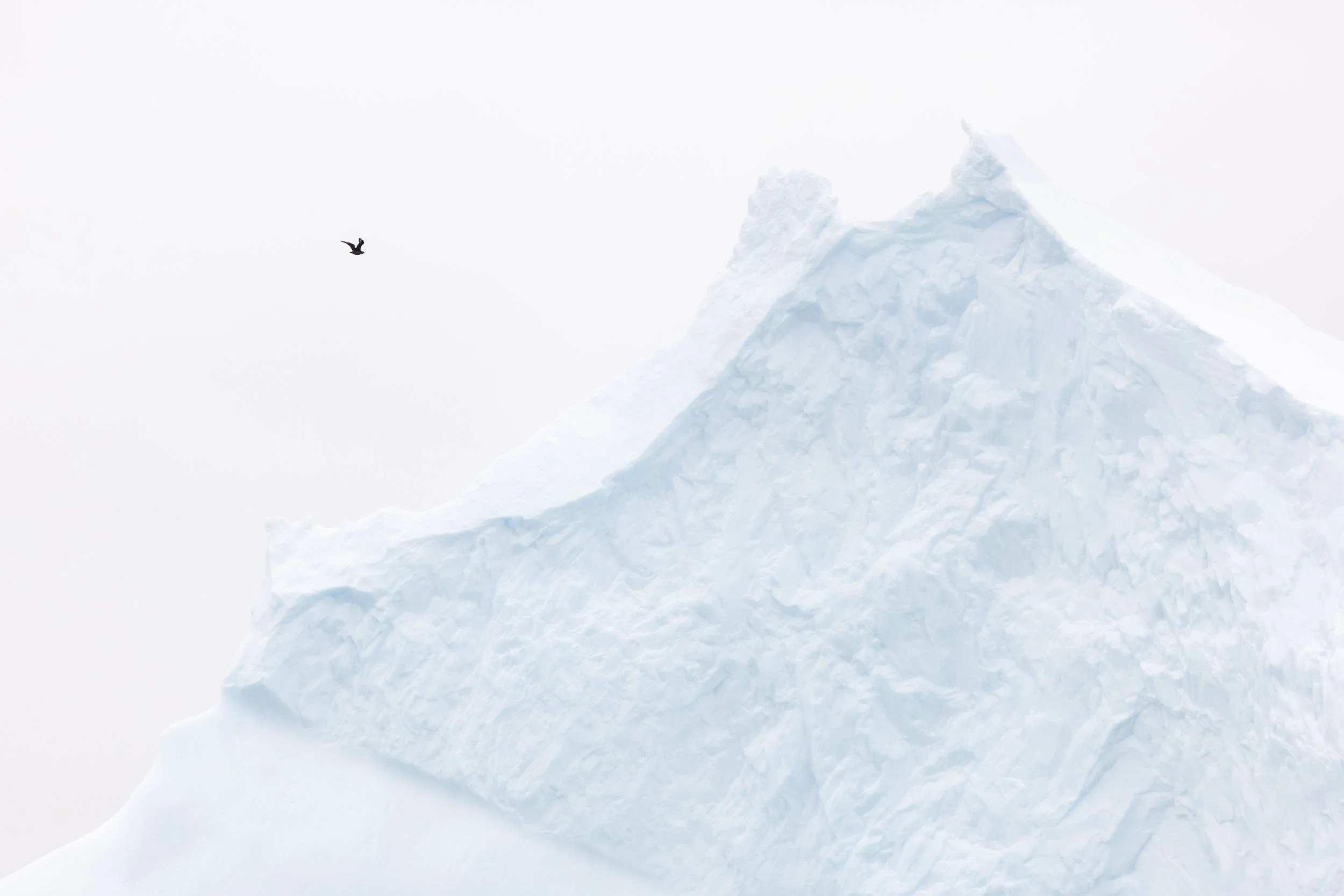
The hosts used the time well. Presentations filled the morning: composition in the field, the specific challenge of shooting from a moving zodiac, the mental discipline of expedition shooting when the light and the landing windows and the sheer volume of subjects create a kind of productive overwhelm. Rachel Bigsby (one of the most decorated bird photographers working today) gave a session on bird photography that covered tonal register, shutter speed on moving platforms, and wing position in flight. On that last point she was precise: in bird photography, the frame you're working toward is full extension, wings open, the bird showing itself completely. I'd been experimenting with exactly this during my solo time along the waterfront, using the seabirds over the strait to work out the timing, and Rachel's session sharpened something I'd only begun to understand. It was the kind of input that changes how you look at a subject, not a technique handed over, but a way of seeing made more deliberate. The specific application of that lesson: how to use an iceberg as a compositional frame and wait for a bird to complete it, is something I came back to throughout the expedition, and it earned a post of its own.
Punta Arenas probably wasn’t prepared for the inundation of such a numerous quantity of long lenses. © Greg Purnell
By afternoon it was clear we weren't flying that day. The decision was made to do a group photo walk through the city — optional, informal, an attempt to make something useful out of a day that wasn't going anywhere else. I'd already spent two days walking those streets alone. I went anyway, because walking a city with James Popsys next to you is a different activity than walking it by yourself.
A utility shack near the waterfront. I clearly still have a lot to learn from James Popsys. © Greg Purnell
Learning How to See
James has a quality that's difficult to describe without sounding imprecise, but I'll try: he notices the gap between what a scene contains and what most people would photograph from it. Not the obvious frame, not even the good frame, but the frame that required a question nobody thought to ask. Walking with him through the streets of Punta Arenas, I found myself stopping at corners I'd passed the day before and seeing them differently, not because anything had changed but because someone was looking at them properly.
Near the waterfront, he zeroed in on a small utility shack (the kind of structure most photographers walk past without registering, a power or services hut, functional and entirely unpretentious). James, it turns out, has a well-documented affinity for huts. He finds them everywhere and photographs them with the same seriousness he brings to anything else. I tried to capture this one. The result was mediocre at best, which I knew even at the time. But something about watching him see it planted a thought that stayed with me for the rest of the expedition and beyond: I was going to look for huts in Antarctica. There were a few, as it turned out, mostly research station outbuildings, and I found them. The real hut reckoning came later, on a future trip to Svalbard with James where the landscape offered a few more opportunities to indulge the habit.
Rachel's contribution was more technical and no less useful. We walked down to the waterfront, where the seabirds were working the strait, and she gave what amounted to a field session on bird photography: shutter speed, tonal register, and the importance of timing the shot to the moment of full extension, wings open, the bird showing itself completely. In Antarctica, where everything is happening at once and the temptation is to chase all of it, knowing exactly what you're looking for in a bird frame is the kind of anchor that keeps you from losing the shot entirely.
Our walk near the beach was a great opportunity to practice bird-in-flight photography. © Greg Purnell
Despite the frigid weather, the beach had numerous swimmers. This little boy patiently held his father’s shoes while he swam. © Greg Purnell
The walk produced lifestyle shots rather than portfolio work: the group moving through the city, people stopping at murals, the particular body language of photographers who have found something worth looking at. Those are the photos that will make the most sense in retrospect, because what they document is the group becoming a group: people who had introduced themselves formally the night before now arguing cheerfully about focal lengths on a street corner in Patagonia.
Aurora, as it turned out, routinely reserves two additional hotel nights beyond the planned schedule specifically because TNM delays are common enough to plan for. The delay wasn't an anomaly. It was a known variable, absorbed into the design of the trip before we'd even left home. There's something clarifying about understanding that. The standby culture the hosts had described at the briefing wasn't just operational guidance: it was the expedition's relationship to uncertainty, expressed as policy. The sooner you internalized it, the better photographer you'd be on the other side.
Opposing views. Seen near the waterfront. © Greg Purnell
The Window
The green light came the following morning. Not with ceremony — with a bus. The weather window at TNM was identified, it was small, and we were going now.
The flight on Antarctic Airways was short, barely enough time to open the meal box they provided for the crossing, which had a map of Antarctica printed on the lid. I noticed it and smiled. We were nearly there.
The uncertainty didn't fully resolve even in the air. If conditions changed on approach to TNM, the plane would turn back to Punta Arenas. We weren't going to Antarctica until we were on the ground in Antarctica, and we knew it. I'm not sure that tension made the flight more dramatic so much as it made everything feel precise and contingent, which is its own kind of sharpening.
We finally boarded our flight bound for Antarctica. © Greg Purnell
A pretty unique and informative airline food box was provided in flight. © Greg Purnell
For a brief moment before landing in Antarctica, the Sylvia Earle peeked into view for the first time, as seen through an airplane window. This would be our home for the expedition, and suddenly it all felt real. © Greg Purnell
The Moment It Became Real
On final approach to TNM, the flight path took us directly over the Sylvia Earle. I saw the ship from the air (small against the water, at anchor, waiting) and something that had been abstract for months became a physical object in the world. That's the ship. That's where we're going. That's what comes next.
There's no adequate way to explain the specific quality of that moment without risking sentimentality, so I'll just say this: Antarctica stopped being a destination and became a place.
TNM is not like any airport I've landed at before. The runway is gravel, laid out beside a small Chilean research base on a stretch of ground that is rocky and windswept and largely indifferent to the concept of aviation infrastructure. The landing gear on Antarctic Airways aircraft is specially designed for rough surfaces; you feel the texture of the ground through the fuselage in a way that reminds you that normal assumptions don't apply here. We taxied to a stop, the door opened, and the air came in.
From there: a bus to the zodiac transfer point, life vests on, muck boots on, luggage already on its way separately. The Sylvia Earle sat in the water ahead of us. The zodiac ride was short and cold and exactly right.
We were provided with muck boots prior to heading to the ship. © Greg Purnell
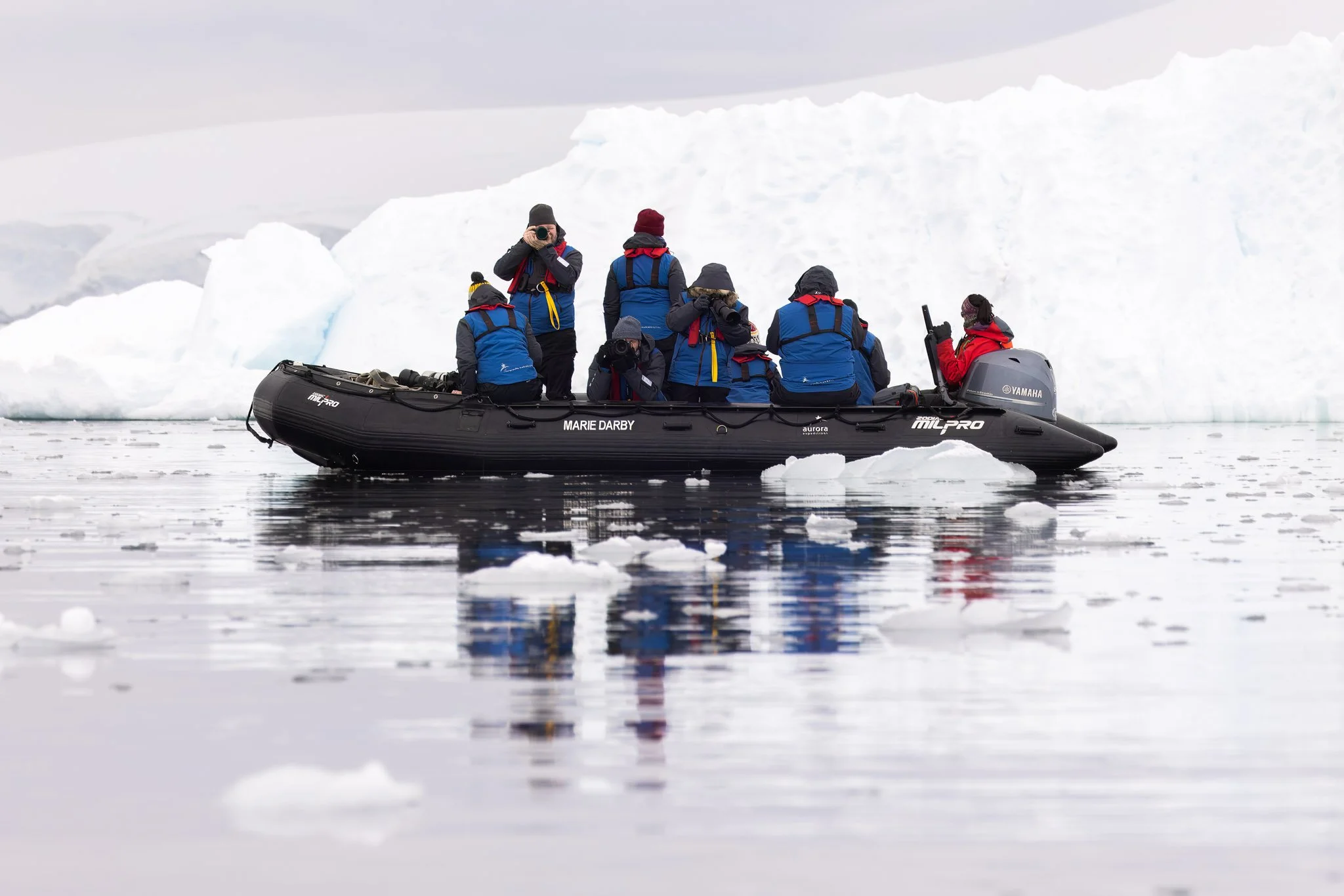
Aboard my very first Antarctic zodiac ride, bound for our new home. © Greg Purnell
The mudroom was the first room we entered on the ship: a functional, utilitarian space that would become the most important room of the next ten days. Every expedition departure began here: dressing, checking gear, waiting for the zodiac briefing. Every return ended here: debriefing, stripping wet layers, the slow re-entry into warmth. By the end of the voyage I'd have a precise and unconscious relationship with that room, with its hooks and its boot racks and the specific smell of damp neoprene drying. On the first day, walking into it for the first time, I just looked around and thought: this is real now.
The ship itself was beautiful: well-appointed, comfortable, and considerably more elegant than the word "expedition" might lead you to expect. It would be our home for the next ten days — the place we'd return to after every landing, debrief, eat, sleep, and go out again.
And then we sailed south.
We made it safely aboard the Sylvia Earle, seen here from Petermann Island. © Greg Purnell
Final Thoguhts
I've thought about those three days in Punta Arenas more than I expected to, given that they were technically the preamble to a ten-day Antarctic expedition. What they taught me (or rather, what they confirmed, in the way that field experience confirms things you almost knew) is that the conditions you're given are not obstacles to the experience. They are the experience. The delay wasn't a day lost. It was a day the itinerary hadn't planned for and the city quietly provided anyway: murals on building walls, seabirds over the Strait of Magellan, a group of photographers becoming a group. The standby culture that the briefing had described as an operational necessity turned out to be a creative philosophy. Show up. Stay ready. Work with what's in front of you. It's the same thing, whether you're waiting for a weather window in a Patagonian port city or standing on the deck of a ship as the Antarctic Peninsula comes into view.
— Greg
Coming next: searching for one specific composition, and how capturing birds in flight amongst the ice is equal parts technique and timing.