What Antarctica Does to a Photographer
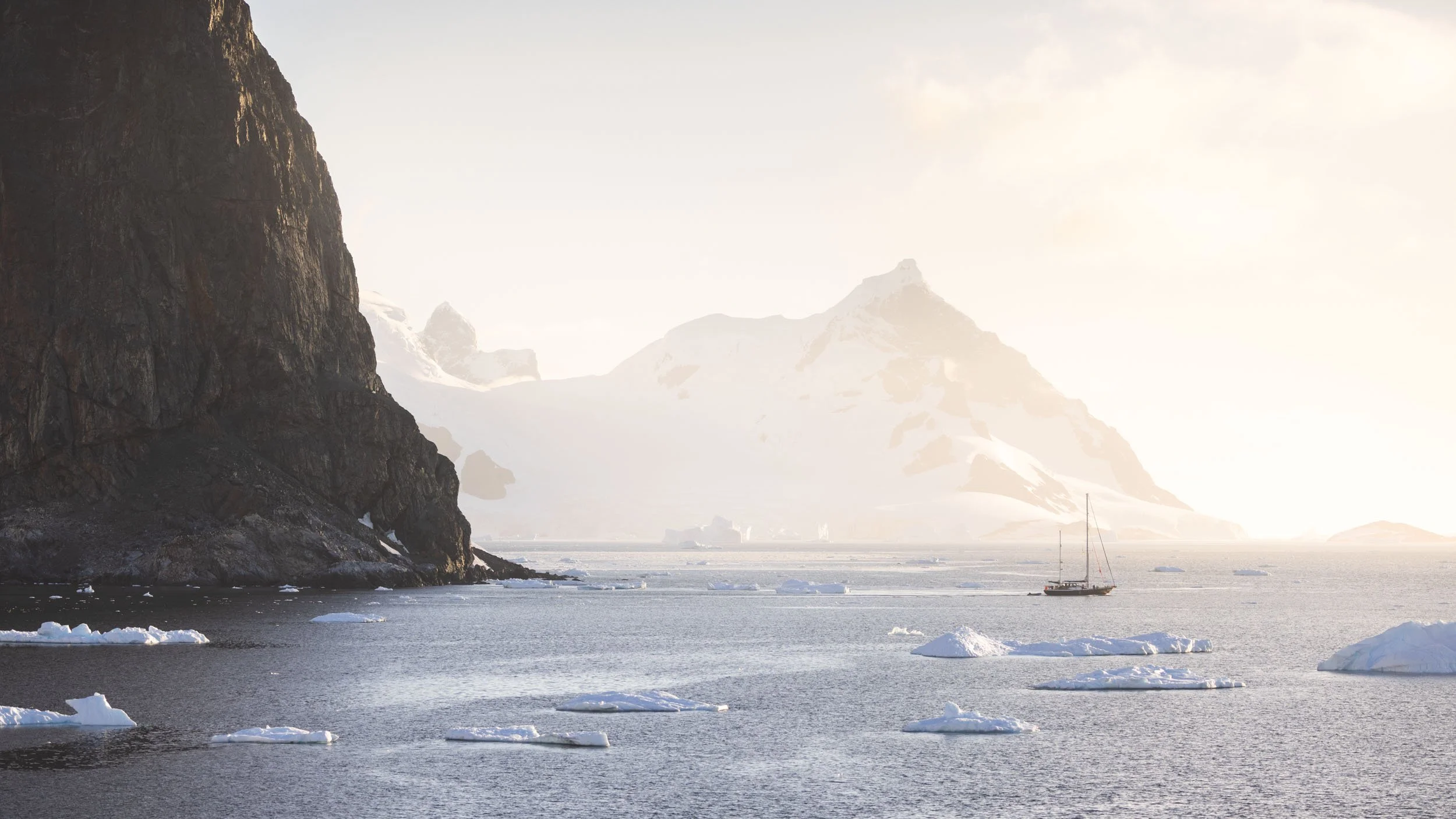
Wearing a pirate hat, I enjoyed my hamburger and side of corn while I watched the most beautiful sunset I had ever seen. In the distance, a lone sailboat emerged from a cove and began working its way through the broken ice. I put the plate down, grabbed my camera, and captured the photograph below. Then I went and got some ice cream — a reasonable choice, I felt, for someone standing in Antarctica.
A lone sailboat navigates the waters of the Antarctic peninsula, February 2024. © GREG PURNELL
Put the Fork Down
Antarctica doesn't wait for you to be ready. The first morning underway, while most of the ship was still at breakfast, someone announced an orca sighting over the intercom and the dining room emptied in about thirty seconds: everyone scrambling for the outer decks, long lenses already in hand, half-eaten plates abandoned on the tables. A small pod was working the water alongside the ship, close enough to stop everything. They moved on in short order, before most people had gotten a shot worth keeping, and everyone filed back to their toast.
That's the rhythm of it. It never stops, and you never stop having to decide whether to put your fork down.
I had arrived aboard the Sylvia Earle the previous evening, still adjusting to the improbability of actually being there. The flight to King George Island had been delayed by over a day (a story you can read about in my other post about getting to Antarctica), and the relief of finally touching down on the gravel airstrip at Frei Station, seeing the ship from the zodiac, stepping through the hatch in the ship's hull and into the mudroom for the first time, was real and immediate. The Antarctic Peninsula was visible through the portholes. We were there, at last. That night, lying in my bunk as the ship pushed south through the Bransfield Strait, I could hear the ice. Not a dramatic sound (nothing like the calving you'd see in a documentary) but a low, intermittent ticking and scraping as bergy bits and growlers grazed the hull, each one announcing itself and passing on. The ship absorbed it without complaint but I lay there in the dark listening to it for a long time before I fell asleep.
Nigel Danson, who organized the photography expedition, had told us a story early on (from his scouting trip for this voyage) about a solitary penguin drifting past the ship on an iceberg in extraordinary light, a photo he captured from the deck that became one of his favorites from that trip. Everyone understood the implication. You just never know: a penguin on an iceberg, a breach off the bow, a shaft of light that lasts thirty seconds. Blink and you miss it. Nobody dared leave their camera in the cabin, and so they remained a constant fixture attached at the hip, from the coffee bar to the dinner table. The Sylvia Earle's outer decks became a continuous shooting platform, and in late February, with barely an hour of darkness each night, that means something close to around-the-clock opportunity.
The first continental landing came at Recess Cove, snow falling, the bay ringed by mountains disappearing into low cloud. We went out by zodiac and stepped onto the Antarctic continent itself, a detail I keep returning to, even now. Others cruised the icebergs instead: deep blue ice in caves, vertical runnels, wave-sculpted surfaces that had taken centuries to form. Humpback whales, which had been surfacing alongside the ship during dinner the previous night, made a return appearance on the way back from the landing, and watching one breach from a zodiac riding low in the water is the kind of thing that makes you understand why people keep coming back to this place.
But before we get to the days themselves, I need to introduce the people who shaped everything that followed.
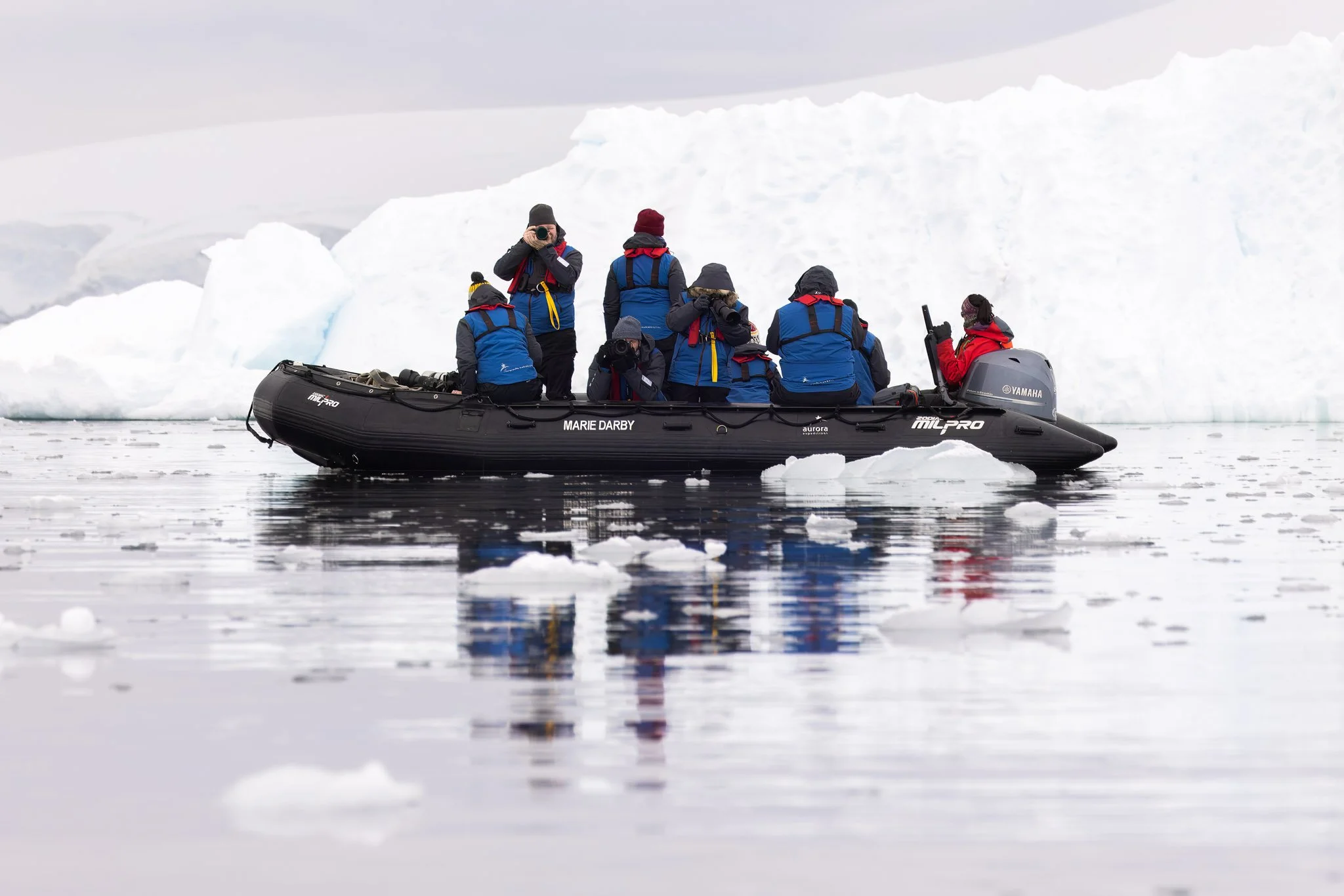
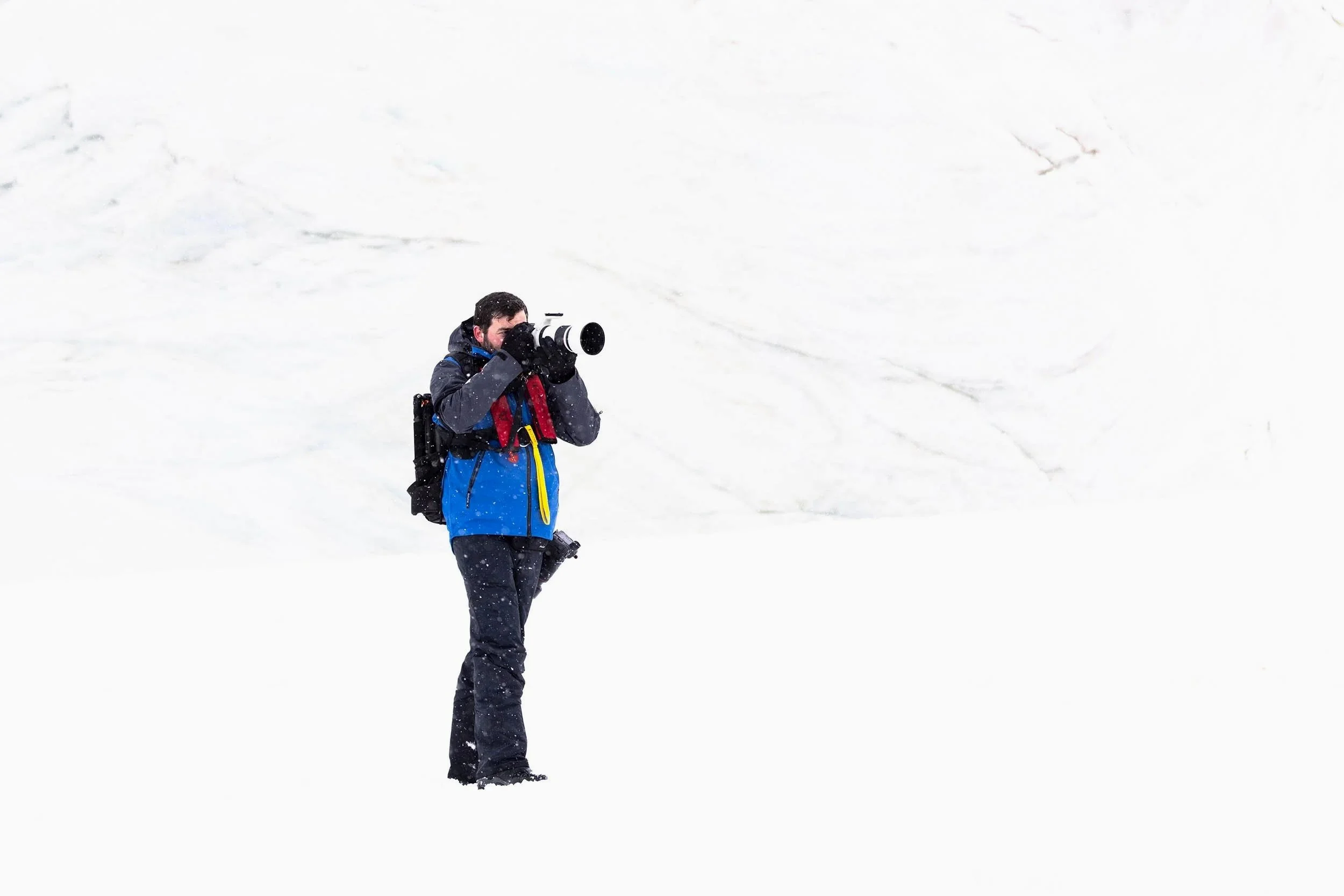
Nigel Danson shooting from a zodiac in Skontorp Cove. © Greg Purnell
A zodiac passes by a recently overturned iceberg in Recess Cove. © Greg Purnell
The Floating Masterclass
Nigel Danson organized this dedicated photography expedition to Antarctica, bringing together a host team of eight photographers, each with their own discipline and visual language, aboard the Sylvia Earle with Aurora Expeditions. Aurora's experienced crew and team of expert naturalists and scientists (more on them shortly) served as our guides on the water and ashore, while Nigel and the hosts ran a floating masterclass alongside: presentations in the evenings, image critique sessions, group editing sessions, and (just as importantly) shooting alongside us in the field every day. The formal and informal were inseparable. You'd get a lecture from Adam on deliberate framing one evening, and spend the next morning in his zodiac watching him apply it in real time.
What makes the format work isn't the scheduled sessions, useful as they are. It's something harder to design for: an entire voyage spent shooting one of the world's most photographically demanding environments alongside people who have each spent years developing a specific, fully-formed visual language. The hosts weren't separate from the experience, they were inside it with us – in the same cold, looking at the same ice, taking their own photos. That proximity reshapes how you see. Not through instruction (it wasn’t a classroom) but through the constant, low-level pressure of working alongside people whose instincts are calibrated differently from yours. You start noticing what you're reaching for automatically, and asking whether that's actually what you want.
I came away with a clearer sense of my own eye than I had going in. Each of these eight photographers left me with something specific: one idea, one reframe, one shift in how I approach a scene. Here's what stuck:
Our eight hosts. From left: Mads Peter Iversen, James Popsys, Dani Connor, Nigel Danson, Jeroen Van Nieuwenhove, Rachel Bigsby, Adam Gibbs, Rick Bebbington. © Greg Purnell
Nigel Danson nigeldanson.com
Nigel's philosophy ("it doesn't get better than this") isn't a catchphrase. It's a discipline: the practice of being fully present in the environment you're in rather than mentally somewhere else, chasing a better shot that may or may not exist. What I noticed watching him work was the absence of urgency. He moved through a scene as if he had all the time he needed, which meant his photos had a stillness to them that mine often lacked. The best shot on any given day was rarely the one you ran toward. It was usually the one already in front of you, if you were paying attention.
James Popsys jamespopsys.com
To this day, I hear James's words echo in my mind with every shot I take: "take photos about things, not just of things." The distinction sounds simple until you try to apply it to every frame. The best photos raise more questions than they answer. They create a tension, a mystery, a reason to keep looking, and in Antarctica, where the subjects are so inherently extraordinary, this discipline is precisely what separates the interesting shots from the merely beautiful ones.
Mads Peter Iversen mpiphoto.dk
Mads edits liberally and deliberately, using post-processing as a storytelling tool rather than a correction tool, shaping photos toward the emotional truth of a scene rather than its literal record. In Antarctica, where the light is already doing extraordinary things, that raises a useful question: what story do you want to tell? The photo the camera records and the photo you present don't have to be the same photo. The gap between them is where your voice lives.
Jeroen Van Nieuwenhove jvn.photo
Jeroen is perhaps best known for his drone documentation of Icelandic volcanic eruptions, but his stills work is equally extraordinary. Antarctica gave it the kind of canvas it deserves. What struck me was how directly his visual language translated: the attention to texture, color, and the relationship between geological scale and intimate detail that he hones shooting lava fields in Iceland maps almost perfectly onto ice and rock and ocean. Different planet, same eye. The tool changes. The vision doesn't.
Rachel Bigsby rachelbigsby.com
Rachel thinks in terms of tonal register (high key and low key) and how the overall brightness of a scene either supports or undermines the story you're trying to tell. For birds in flight, she's unequivocal: shutter speed above everything else, and on a zodiac, double what you'd use on land, because the platform is moving even when you think it's still. She also made a point that has stuck with me: there is no such thing as a seagull. Know your species. Know your subject. The specificity of your attention shows up in the photo.
Dani Connor daniconnorwild.com
Fast glass changes the equation entirely. Dani shot wildlife with a Canon 400mm f/2.8 (that aperture lets you run shutter speeds that would otherwise require sacrificing ISO, and the results show it). But the deeper takeaway was about something harder to quantify: when you bring genuine empathy to a subject (real curiosity, real patience, real care) it comes through in the photo. The animal feels it. The viewer feels it. Technical decisions matter, but they're in service of an attention that has to be there first.
Adam Gibbs adamgibbs.com
This was not Adam's first Antarctic expedition, and the difference showed, not in the volume of shots, but in the deliberateness of each one. He shot exclusively in the 65:24 panoramic ratio on a medium format Fuji digital body (the XPan format), a constraint that forced every composition to justify itself. The resulting photos have a restraint and intentionality that I found quietly revelatory. Take a breath. Work the scene. Let the shot come to you rather than running after it. I heard it clearly. I didn't follow it nearly well enough.
Rick Bebbington rickbebbington.com
Rick's stills work is immediately recognizable: clean, intricately composed, every element in the frame earning its place. What I didn't expect was how that same precision extended to the trip itself. He spent much of the voyage shooting video alongside his photography, not as an afterthought but with equal intention, and at the end of the expedition shared a recap that captured something the still photos couldn't quite reach on their own: the feeling of being there, moving through it, together. It was one of the most affecting things I experienced that week, and it wasn't a photograph.
Mads Peter Iversen, right, choosing his subject carefully. © Greg Purnell
Rachel Bigsby, center, offering her guidance near Port Charcot. © Greg Purnell
The format gave me something I hadn't fully anticipated: real creative agency over how each day unfolded. The group divided into separate zodiacs for each outing, with one host photographer in each. As a guest, you had the opportunity to choose your zodiac. You effectively chose your companion for the session.
I tried to mix it up based on conditions and what I was hoping to capture. Smooth water and good reflection potential? I'd find Mads, because his eye for that kind of landscape precision is unmatched. Buildings or stations on the agenda? I'd look for James, whose approach to human-made environments in wild contexts is one of the more interesting things I've seen. If whale sightings were likely, I'd try to position in the zodiac with the ship's whale expert, because shooting alongside someone who can tell you what a humpback is about to do next changes what you reach for.
There's an honest corollary to this, though. Your experience was also shaped simply by which boat you were in. Different zodiacs went to different parts of the landscape. Sometimes one boat would find a seal on an iceberg and radio the others to come, but by the time everyone arrived, the perspective may have shifted or the animal may have moved. This is not a flaw in the format. It's a feature of the place. Antarctica doesn't distribute its moments evenly. What it does do is give everyone a different story, and every story is equally true, just seen through a different eye. It was something I had to keep reminding myself of, right up until the moment I saw how differently someone else had seen the same light.
The same was true of the guests, not just the hosts. Rhiannan Lawler and Arthur Childs, for example, I've shot with again since, on other trips and one-off sessions. That kind of compression has a particular talent for making friendships permanent.
Scale is difficult to judge when there are minimal points of reference. This glacier and accompanying mountain were indescribably massive, and I struggled to capture the gravity of the in-person experience. © Greg Purnell
The Weight of Being Here
I want to pause here, because writing about Antarctica honestly requires first saying something specific about what it felt like to be accountable to it. I noticed it on the first landing. Standing among creatures that have no framework for what you are, in a landscape with no infrastructure built around your convenience, you stop being a photographer working a location and start feeling like a guest in a place that didn't invite you. That shift in how you hold yourself turns out to matter photographically, and not in ways I fully expected.
Antarctica is not a destination in any conventional sense. The continent has no permanent human population and is governed by international treaty. A relatively small number of people visit each year, and most of them on expeditions like this one. There is a weight of privilege in being there that I felt constantly. The responsibility to tread carefully, photograph respectfully, and leave nothing behind is baked into every IAATO briefing and every landing procedure.
The wildlife operates on a framework of complete fearlessness (not the showy, performative kind, but the indifferent kind, which is actually far more interesting to photograph). These animals have simply never developed a threat response to humans. It’s not because they're tame, but because we simply haven't been here long enough, or in sufficient numbers, to register as a threat.
When I visited in February 2024, that responsibility felt more acute than usual. Avian influenza was spreading through bird populations globally at a speed that had scientists alarmed. It had not yet reached Antarctica. The biosecurity protocols on every landing (boot rinses, clothing inspections, the careful checking of every piece of gear for traces of foreign soil) weren't bureaucratic inconvenience. They were the difference between a healthy ecosystem and a potential catastrophe. One contaminated boot. One sick penguin. A colony of thousands in close contact. Nobody on that ship needed the math explained.
Boot sanitization was a requirement on every return to the ship. © Greg Purnell
Our incredible Aurora Expeditions E Team. Photo courtesy Vanja Davidsen.
Aurora Expeditions and the Expedition Team took all of this seriously in a way that felt less like policy and more like conviction. The E Team (led by Christian, the ship's Expedition Leader) were working scientists and specialists: ornithologists, marine biologists, cetacean experts, geologists, glaciologists, historians. They brought their fields to life in ways I hadn't expected. The ship's geologist explained that glacial ice forms in the same way rock does, compressed over millennia under its own weight, which means the ice we were photographing was as old as the geological record beneath it, and that the deep blue color of ancient ice comes from air being slowly squeezed out of the crystals over thousands of years, until almost nothing is left but pure frozen water. I had never thought about ice that way before, and I never looked at an iceberg the same way after. The marine biologist's briefing on humpback whale behavior before our first encounter fundamentally changed how I approached photographing them. They are, without exaggeration, exceptional.
I was aware, in a way I've never quite felt on a trip before, that what I was looking at was changing. Climate change is reshaping Antarctica faster than most people realize. The glaciers I photographed are not the glaciers that will be there in twenty years. The ice formations, the wildlife patterns, the very geography of the place: all of it is in motion. Every shot I took felt less like a creative decision and more like a record. A document of a specific place at a specific moment in time that will never exist in quite the same way again. That's a lot of weight to carry through a viewfinder. It is, I think, exactly what photography is for.
Which is perhaps why the act of photographing here felt more purposeful than it has anywhere else I've been.
Three gentoo penguins march along a cliff near Port Charcot. © Greg Purnell
Everything, All at Once
Here is the thing about shooting in Antarctica that I didn't fully anticipate: the technical challenges are real (the light shifts constantly, some days you never see the sky, the zodiac is always moving) but they're not the thing that catches you off guard. What catches you off guard is the sheer volume of it. Antarctica delivers at every level simultaneously: foreground, midground, and background all active; sky, ice, water, and wildlife all in motion; the light doing something interesting in one direction while something remarkable happens in another. The decision-making overhead of figuring out what to prioritize, and what to let go, runs continuously and quietly in the background until, somewhere around the third day, you realize it has been wearing you down the whole time.
The days followed a consistent rhythm: up early to shoot from the outer decks in the extraordinary polar light, at least two outings daily by zodiac or landing, and evenings aboard for editing, critique sessions, and presentations by the hosts or E Team members on topics connected to wherever we'd been. The days were full, and the learning happened everywhere: in the theater and in the zodiacs, at the dinner table and on the outer decks at midnight when the sun was still technically above the horizon.
Between every outing, I was running a logistics cycle that had to happen without exception: clear memory cards, back up to two separate SSDs, recharge batteries, and repack and clean every lens and camera body. That last part is non-negotiable in these conditions. Shooting from a zodiac in Antarctic weather means your gear gets soaked with water (both fresh and salt), and salt water is insidious. It has a wonderful way of working its way into metal contacts and mounts and causes corrosion that shows up weeks later, long after you've forgotten the specific wave that caused it. Between every shoot, without exception, I was removing lenses, wiping down elements, cleaning with fresh water, and allowing everything to dry before the next outing. It adds thirty minutes to every turnaround, and in Antarctica those thirty minutes are usually the only real downtime in the day. (More on my full cold-weather kit, including what survived and what didn’t, in a separate post)
My solution to the volume problem, imperfect as it was, was to commit to each landing with a single primary intention (a species, a quality of light, a compositional constraint) and use that as an anchor against the pull of everything else. It helped. The better solution, which I know now and didn't fully trust then, was simply to slow down. The hosts told us before our first penguin colony: "There will be so many more penguins to come. We promise." I heard it. I didn't really believe it, which meant I shot that first colony as if it were the last one, which is exactly the wrong approach.
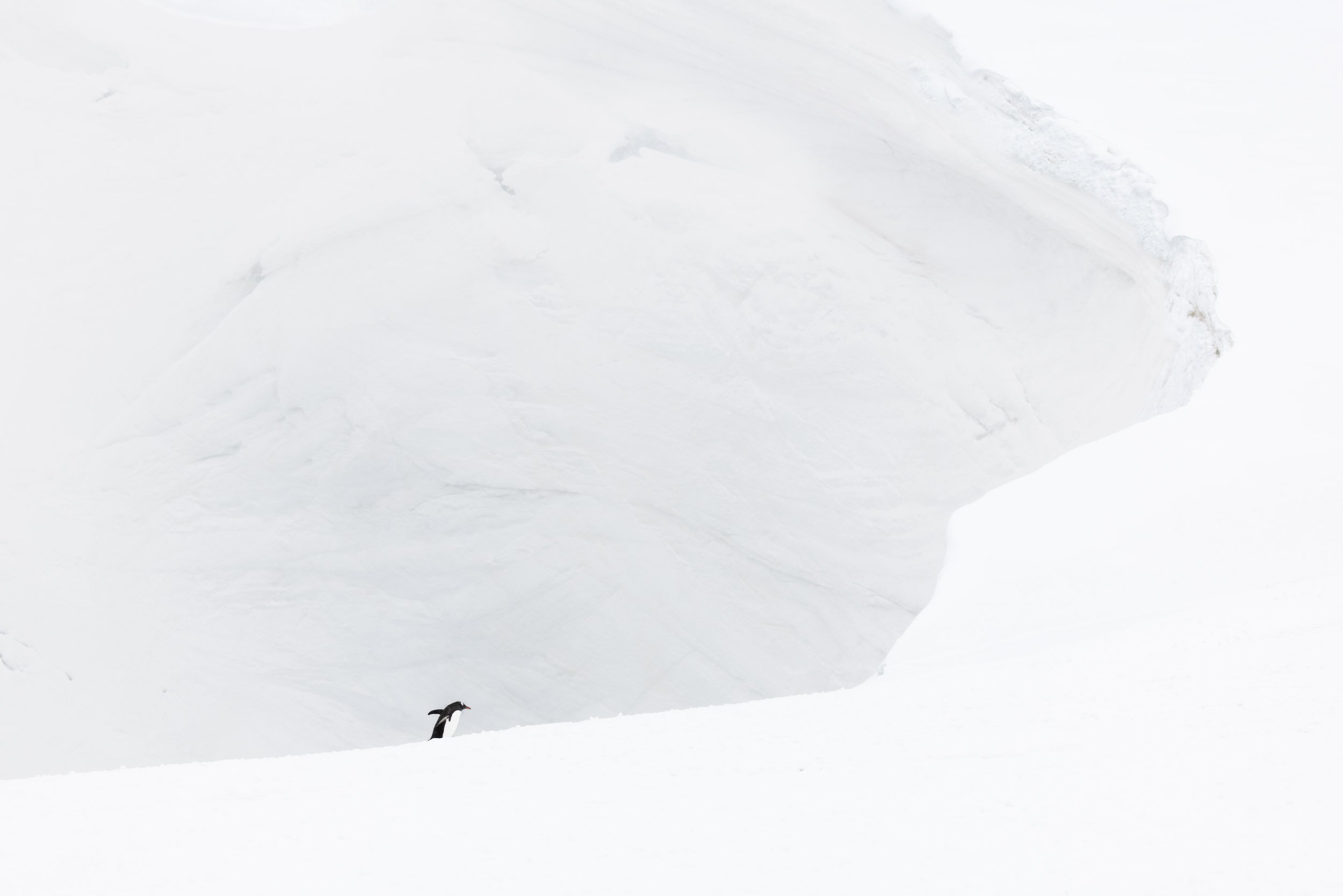
The landings that worked best were the ones where I let the scene come to me. On Day 11 at Half Moon Island we had a relaxed landing with no schedule pressure, and I spent the better part of twenty minutes with a single Gentoo penguin who was clearly going somewhere important and equally clearly had no intention of going there any faster. I took portrait shots at close range, natural light, and let the subject do all the work. Those are some of my favorite photos from the entire trip, not because the conditions were special, but because I was finally present enough to be in them rather than chasing the next thing.
The between-outing time on deck was where I started to understand what slowing down actually meant in practice. Standing at the rail while the ship repositioned, storage cards already backed up and charging below, there was nothing to do but look. The light in Antarctica in late February has a particular quality (low and directional even at midday, wrapping around surfaces rather than flattening them) and the silence on deck was its own kind of sound: wind, water, the distant calling of seabirds, and underneath all of it the occasional groan of the ship's hull adjusting to a swell. You stop scanning for the next shot and start actually seeing what's in front of you.
The patterns and shapes in the ice could keep this photographer occupied for days. © Greg Purnell
Part of what you start seeing, if you slow down enough, is the ice itself — not as scenery or as foreground interest, but as a subject. I've spent time around ice now in Antarctica, in Svalbard, in Greenland (which you’ll learn more about in future posts), and what I keep coming back to is how completely each piece is its own thing: a particular history of compression and thaw and movement written in color gradients and fractures and surfaces that catch light differently depending on their age and density. No two icebergs are the same, in the way that no two pieces of geological time are the same. And they're not static. From a zodiac with the engine cut, you can hear it: a faint, high crackle, almost squeaky, as the ice shifts and revolves and breathes in the water. It's the sound of something ancient doing what it has always done, indifferent to your presence, and it is one of the more unexpectedly moving things I have encountered behind a camera.
Antarctica, to its credit, also knew when to cut the seriousness. On Day 9, thirty-eight of us voluntarily entered the Southern Ocean at Borgen Bay, which has nothing to do with photography and everything to do with what happens when peer pressure meets a very specific kind of once-in-a-lifetime logic. Swimming there amongst the ice earned me my place as a certified member of the Society of Antarctic Plungers. I felt in that moment like I was just that much closer to understanding what it was like to be a penguin.
In all of the excitement, it’s important to remember to slow down. © Greg Purnell
A solitary chinstrap penguin navigates a penguin highway near Orne Harbour. Yes, penguins make highways. © Greg Purnell
On the Animal's Terms
Antarctica's wildlife is unlike anything I've encountered in pointing a camera at animals. Not because of the species (extraordinary as they are) but because of the terms. Every encounter here happens on the animal's terms, entirely and without exception, in a way that produces a completely different kind of photograph from what you can take anywhere else on earth.
A gentoo penguin waddling about near Port Charcot. © Greg Purnell
Penguins
You smell a penguin colony before you see it. The scent arrives on the wind some distance before the birds do (guano and fish and something ancient and biological underneath it all) and it tells you you're close in a way that no amount of looking at the horizon quite does. Then the sound arrives: a constant, low churning of thousands of individual birds going about their business. And then, finally, you crest whatever ridge or snowfield you've been climbing and the colony opens up in front of you.
We visited Adélie and Gentoo colonies at Petermann Island, with their molting youngsters (birds caught between juvenile and adult plumage, patchy and slightly ragged, looking like they'd had a disagreement with a pillow) and Chinstraps at Port Charcot and Orne Harbour, colonies stacked up cliff faces above the water. And then Half Moon Island (where the slowing-down finally clicked) with its Chinstraps and Gentoos and the one particular bird who spent twenty minutes being magnificently indifferent to my presence. You can get close, stay close, and wait (no telephoto required, no stalking, no hiding). You just stand there, and they live their lives, and if you're paying attention, something happens.
The penguins in the water were something else entirely, and considerably harder to photograph. Swimming in groups near the surface, they porpoise in quick succession (launching out of the water in unison, sometimes three or four at a time, before diving back under in a single fluid movement). I have one photo of three of them clearing the surface simultaneously that I'm very pleased with, and I want to be honest about the ratio: that photo required a lot of frames and a lot of luck, because by the time you've registered what you're seeing, raised the camera, and composed, they've already gone back under. More on the specific technique in an upcoming post on shooting from a moving zodiac.
A colony of gentoo penguins on Petermann Island. Can you smell them from here? © Greg Purnell
A baby gentoo feeding from its mother’s mouth on Petermann Island. © Greg Purnell
A gentoo penguin out for a morning stroll on Petermann Island. © Greg Purnell
The rapid porpoising of these Three penguins near Skontorp Cove was an exciting challenge to capture from a moving boat. © Greg Purnell
Seals
The leopard seal near Petermann Island lifted her head once, clocked us, filed us under "not a threat," and went back to existing. She was 3.5 meters of absolute apex predator, completely unbothered, and the shots I took (wide enough to show scale, close enough to show texture) are some of my favorites from the trip. Up close, her teeth were remarkable: not the flat, whiskered profile you might expect from a large marine mammal, but something far more shark-like, tri-pointed and serious, built for a diet that is not krill. There happened to be no penguins nearby at the time, which I noted with some relief. The zodiac had cut its engine and we drifted in silence, or what passes for silence when you're among floating ice: a faint, high crackle as the floe shifted and settled, the particular sound of compressed centuries adjusting to the water temperature, present beneath everything else like a low continuous note. The occasional click of a shutter. Nobody said anything. Everyone understood without being told that this was a moment to be in, not to narrate.
The crabeater at Skontorp Cove was an entirely different specimen: improbably round, perfectly posed on a flat-topped ice floe, backlit by flat gray sky. It looked staged. It wasn't. At Half Moon Island we encountered Weddell seals (compact and dark, hauled out in small clusters on the snow, wearing the particular expression of animals who have decided that whatever you're doing over there is deeply uninteresting) and elephant seals, the males enormous even by Antarctic standards, apparently indifferent not just to us but to the concept of movement in general.
A distinguished Antarctic Fur Seal in Port Charcot. © Greg Purnell
A leopard seal On an ice floe near Skontorp Cove. She clocked us, filed us under “not a threat,” and went back to existing. © Greg Purnell
An antarctic fur seal just up from their mid-morning nap on a small ice floe in Borgen Bay. © Greg Purnell
Seabirds
The seabirds are a constant: present at virtually every location, in remarkable numbers, doing interesting things at all times. Giant petrels drifted past the dining room windows mid-passage. At Skontorp Cove, a colony of blue-eyed shags occupied the cliff face at Shag Rock, the surrounding rock cut through with veins of malachite in a green so saturated it reads as artificial (one of the more visually surprising things I encountered on the entire trip). Wilson's storm petrels threading through ice near Wordie House in light that arrived and disappeared in a window of about four minutes. (More on composing birds against ice in another post.) Antarctic terns everywhere, quick and precise, working the water with the kind of efficiency that makes you feel like you're always slightly too slow with the camera.
Rachel's lesson about shutter speed on a moving platform rang in my ears throughout every zodiac session, and I can confirm it was exactly right. The seabirds reward patience and fast reflexes in roughly equal measure. The whales require something else: a willingness to simply wait, and the presence of mind to be ready when the water breaks.
An Antarctic Tern in flight near Winter Island. © Greg Purnell
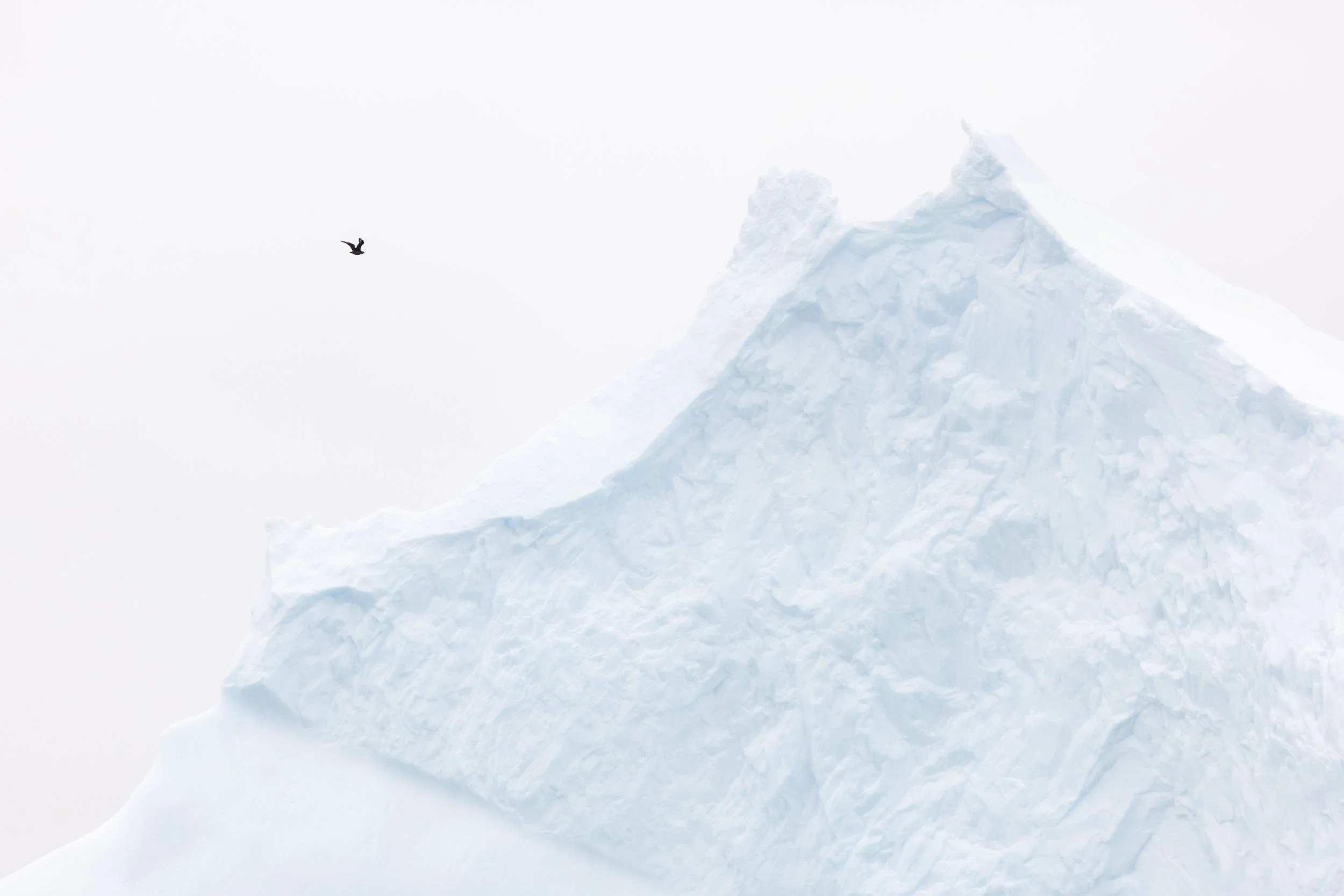
A kelp gull near Winter Island. I loved finding compositions which isolate birds with ice bergs against a void. So much so that I have a whole Birds and Bergs series from this trip. © Greg Purnell
Whales
On Day 10, crossing Graham Passage, we played whale tennis. This is not a formal game. It involves running from the port rail to the starboard rail as the whale count doubles over lunch, because humpbacks kept surfacing on whichever side you weren't standing on. At Skontorp Cove we had drifted in tranquillity until a huge rumble and crash of calving ice sent swells rolling under the zodiac, and a crabeater seal appeared on the bergy-bit that emerged. At Borgen Bay, a minke whale worked the water while penguins and seals did their separate things on the ice nearby. And on the first morning underway, the orcas that emptied the dining room in thirty seconds established what would become the defining rhythm of the trip: Antarctica keeps interrupting, and the answer is always to put the fork down.
The closest humpback encounter came in Paradise Bay, where one surfaced alongside the zodiac near enough that we could hear the exhalation before we saw the animal (a deep, wet percussion that seemed to come from inside the water rather than above it, followed by the slow arc of the back and then the flukes lifting, the white undersides catching the flat gray light as it dove). Nobody said anything. There was nothing to say.
A humpback whale showing its fluke in Paradise Bay. This particular whale appeared remarkably close to our zodiac, and I was happy to have my wide angle at the ready. © Greg Purnell
The wildlife, in other words, was the part that worked. The camera and the subject were on the same terms: close, patient, indifferent to my presence in the most useful possible way. The landscape was a different problem entirely.
An Antarctic fur sea enjoying a nap with a view near Port Charcot. © Greg Purnell
Right Place, Ridiculous Hat
Mads talks a lot about scale: specifically about the human element as a unit of measurement in a landscape. A person in the frame gives the viewer something to calibrate against. Without it, a mountain can be magnificent and still feel abstract, because there's nothing to tell you how big “magnificent” actually is. In Antarctica, where the mountains are enormous and the ice formations are ancient, that problem is real and mostly unsolvable. I took a lot of landscape shots on this trip that I'm pleased with technically and frustrated by photographically, because what the camera recorded and what it felt like to stand there are two different things, and I haven't fully closed that gap.
The exception arrived on the evening of Day 9, while I was wearing a pirate hat and eating a hamburger.
Aurora had set up a barbecue on the outer deck: an extensive spread, eaten outside in the cold of the Southern Ocean, which sounds miserable and was in fact one of the best meals of my life. They'd also provided a box of silly hats: top hats, sombreros, sailor's caps, pirate hats. Ninety photographers and expeditioners, eating corn on the cob in Antarctica while wearing ridiculous headgear, watching what I'm fairly confident was the most beautiful sunset I have ever seen. The sun in late February at those latitudes doesn't so much set as gradually reconsider the idea, and the light it produces on the way down (low, warm, wrapping around every surface it touches) is the kind of light that makes you understand why photographers keep coming back to this part of the world.
I was working through my corn when a lone sailboat emerged from a cove in the distance and began making its way through the broken ice. Something any viewer would recognize. Something with a size relationship to the mountains and the ice that communicates immediately, without effort, without any compositional problem-solving on my part. I put the plate down and grabbed the camera. The light was hitting the rocky Antarctic shore behind it in a way that felt almost staged, and I knew while I was taking the shot that it was the best landscape photograph of the trip: not because I'd done anything particularly clever, but because the scene had briefly solved its own problem and I happened to be standing there with a camera.
The scale problem is what the landscape gives you. What eight photographers do with the same landscape, the same light, and completely different instincts is a different question entirely, and one the critique sessions spent the better part of a week answering.
The only reasonable way to end an Antarctic sunset BBQ: Ice cream. © Greg Purnell
Vertical mountains and endless glaciers meet the sea as we pass through the Lemaire Channel. The light was a bit flat, but the landscape was captivating through and through. © Greg Purnell
No Wrong Answer
Having your work assessed by photographers you admire, in front of a room full of people who also know what they're looking at, is one of the more clarifying experiences available to a photographer who is serious about improving. The format was simple: submit a photo from the trip so far, and the hosts would respond to it. What happened in practice was more complicated, and considerably more useful.
Often, the hosts would agree. A horizon slightly off, a subject not given enough room to breathe, a distracting element in the corner that could have been resolved by moving two steps to the left. Useful, concrete, immediately applicable.
I use Adobe Lightroom Classic for cataloging and Post-processing — an important part of my process. I regularly re-crop my images and apply edits to bring them in line with my vision, though everyone has a different approach. More on this in a future post. © Greg Purnell
But occasionally they'd disagree. Adamantly. One would see a compositional choice as a strength; another would flag it as the central problem. One would praise the restraint in the edit; another would push for more drama. I had photos in these sessions that split the room, and sitting with that (watching photographers I respect arrive at opposite conclusions about the same frame) was clarifying in a way that no consensus could have been. Photography is art. Art doesn't resolve neatly. The "rules" are frameworks, not laws, and watching world-class practitioners disagree about their application is a direct, visceral reminder that your instinct, your voice, your eye are valid variables in this equation. There is no single correct photo. There is only the shot you intended to take, and whether you took it.
The group editing sessions worked the same way. During the rare stretches of downtime between landings, many of us would gather in the lecture theater to start working through the day's shots. There is something unexpectedly revealing about watching someone else edit the same light you both stood in: the decisions they make, the tones they reach for, the elements they choose to suppress or amplify. You see the world through someone else's eye, briefly, and it shifts something in your own. I came away from several of those sessions and went back to photos I'd already processed and started again from scratch.
All of this was still somewhat abstract until the final night.
From left: Nigel Danson, Mads Peter Iversen, and James Popsys address the group in the lecture hall. © Greg Purnell
Same Light, Different Eye
At the end of the voyage, everyone submitted their strongest, fully edited shots from the trip. They were assembled and screened for the whole group in the lecture theater on the last evening aboard (the same room where we'd had critiques, editing sessions, E Team presentations, and more conversations about photography than I'd had in any comparable stretch of time in my life).
What made the evening different from everything that came before it was seeing the complete picture. I had seen some of their photos in critiques and editing sessions, glimpsed others over shoulders during downtime, but this was the first time seeing their best work, intentionally sequenced, all together. And what I wasn't prepared for was recognizing my own moments inside other people's photos. A zodiac I had been in, a landing site I had spent an hour at, a stretch of light I thought I knew (and there it was, seen from a different angle, with a different eye, telling a completely different story). Same place. Same moment. Same cold. An entirely different photograph.
This is what perspective actually means, made visible and concrete in a single room. Not an abstract principle about visual languages. A side-by-side demonstration, in real photos from a shared experience, that there is no single correct version of a scene. Everyone tells the truth. Everyone tells a different truth.
Eye-opening is the closest word for it. But it doesn't quite reach it.
The room afterward had the quality of people who aren't ready to leave but know they have to. The Sylvia Earle was now on its way back to King George Island so we could fly back to Chile the next morning. Most people had onward flights from there, itineraries already locked, connections to make. There were conversations that went long that night, drinks that nobody was in a hurry to finish, the particular warmth of people who have been through something together and know they're about to scatter back to their separate lives. I was heading in a different direction (meeting some friends to embark on a backpacking trip in Patagonia).
Fortunately or not, Antarctica had other plans for us.
The Sylvia Earle is dwarfed by the surrounding landscape on A windless morning in Borgen Bay. © Greg Purnell
Antarctica's Last Word
The plan had us disembarking at King George Island on Day 12, flying back to Punta Arenas, and heading on our separate ways. Antarctica had its own agenda, as it so often does. Christian gathered us in the lecture theater to announce that there would be no flights today, tomorrow, or the day after. There was a slim chance on Thursday, but uncertainty loomed. The best option would be for the ship to sail north instead, across the Drake Passage, and a charter flight from Puerto Williams would deliver us to Punta Arenas when the crossing was done.
The room absorbed this quietly. Most people had connections to rebook, itineraries to unravel, the particular headache of international travel plans going sideways, and finding a way to rectify this with a weak internet connection from one of the most remote places on Earth. I was possibly the only person on the ship who, privately, was something close to pleased. Crossing the Drake Passage was itself a life ambition I had carried since childhood, formed by National Geographic documentaries and the Drake's infamous reputation as home to some of the roughest open water on the planet. It looked terrifying. It was not for the faint of heart. And it had just landed in my lap unexpectedly.
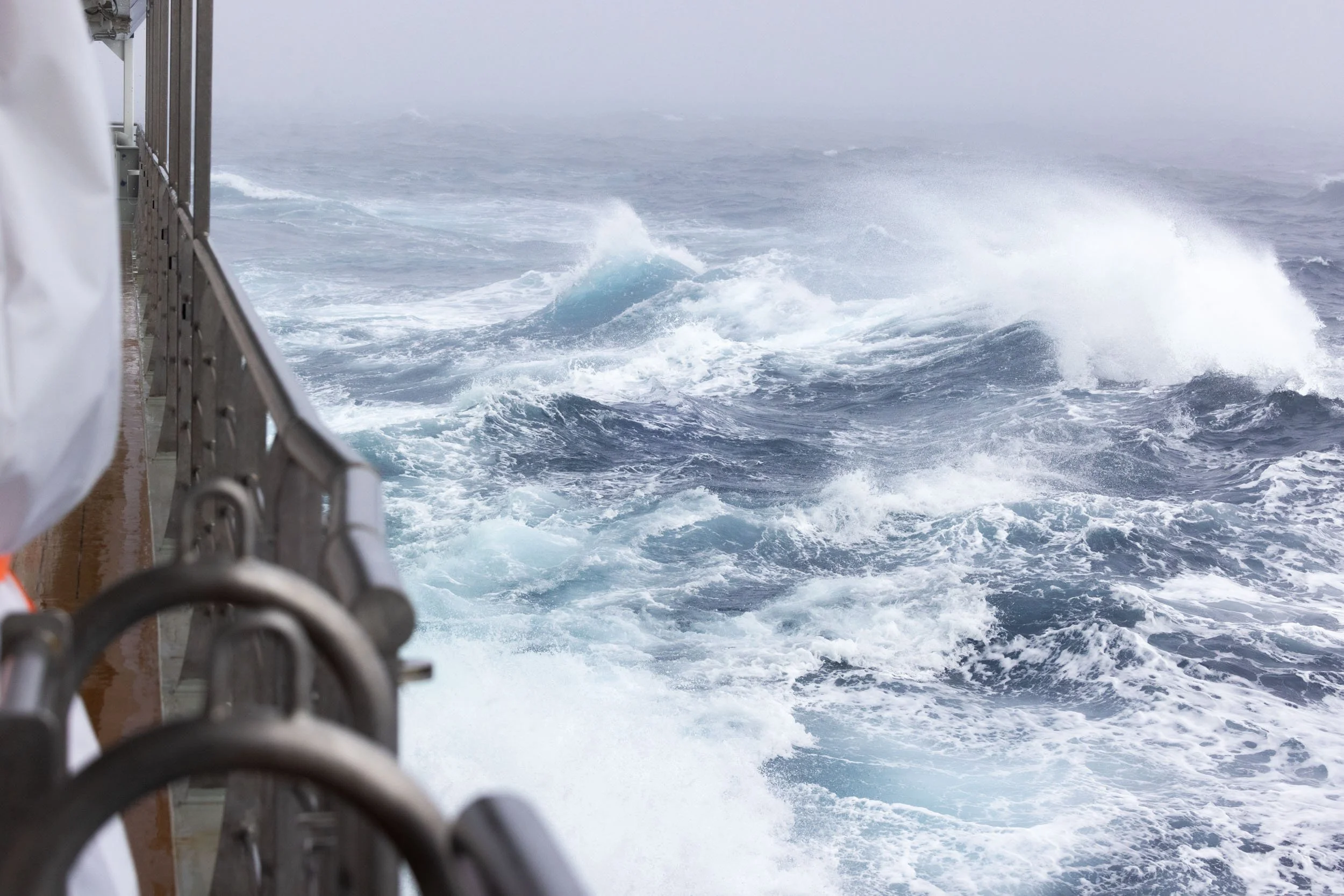
The swells ran 4-6 meters. The Captain was completely unfazed (he'd seen these waters reach 10-12 meters before, he’d said, and described our conditions with the equanimity of someone for whom this was a moderately interesting Tuesday). Many of my fellow expeditioners spent the 2.5-day crossing in their cabins. My stomach was fine, which I'm aware is a matter of luck rather than constitution. While the outer decks were still accessible, I went down to the lower level, sat on the deck (standing wasn't a realistic option), strapped both cameras to my body, and shot the waves through the railing. A flock of Cape Petrels appeared and spent the better part of an hour surfing the wind that swept up over the crests of the swells, riding the air with a casualness that made clear the Drake Passage was their element, not mine. (Read more about my journey across the Drake in my post: The Drake Crossing: The Raw Power of the Southern Ocean.)
A trio of Cape Petrels surf the waves in the Drake Passage. © Greg Purnell
The swells of the Drake Passage, seen from the Sylvia Earle. The crew closed the outer decks for safety shortly after this. © Greg Purnell
I woke on the third morning to darkness at 6am, real darkness, for the first time since arriving in Antarctica. The ship had moved far enough north that the sun was only just beginning to show above the horizon, and the long polar days that had defined every morning of the voyage were suddenly gone. We were navigating into the Beagle Channel, where the mountains of Tierra del Fuego rose on either side and the Southern Ocean gave way immediately to smooth, protected water. The crossing was over.
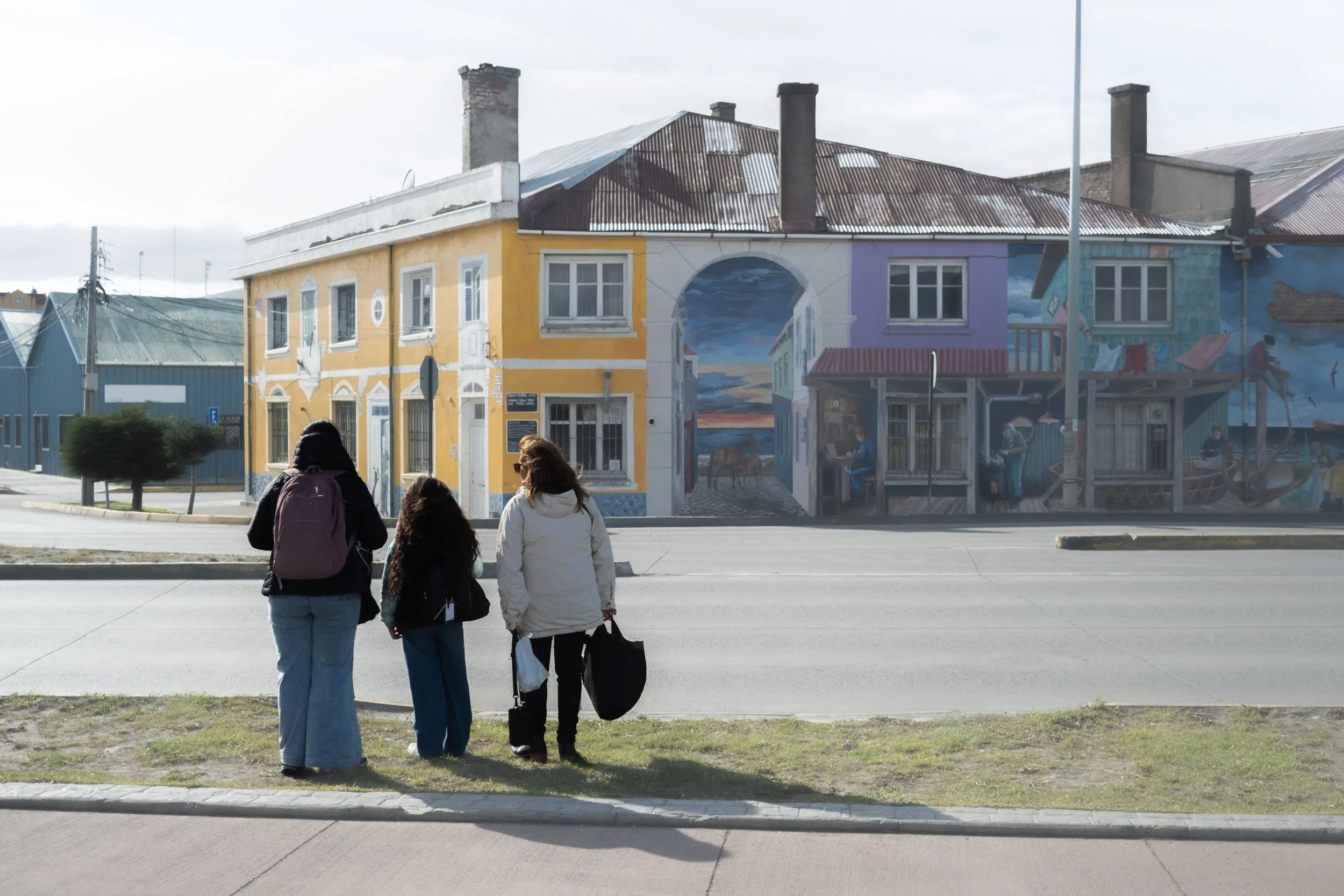
Puerto Williams appeared on the shore. We disembarked by zodiac for the last time, said goodbye to Christian and the E Team and the Aurora crew, and waited for the airport buses in a small Chilean port town that turned out to have surprisingly excellent street photography potential, if you were willing to stand in one place and let things happen. James, Rick, and I were, for about thirty minutes, which felt like both enough and not enough at all.
We flew to Punta Arenas. The hosts were waiting for their own onward travels, and the goodbye was warm and slightly insufficient, as goodbyes to people who have genuinely changed how you see tend to be. The other expeditioners were there too: people who I now knew in the specific, compressed way you get to know people you've shared something extreme with. The airport had a particular quality as a farewell venue: everyone was already in motion, already pointed at the next thing, which made it slightly easier. I was pointed at Patagonia. The backpacking trip, now already underway on the W-trek without me, meant I needed to somehow repack an expedition photography kit into a backpacker's pack and catch up with my friends. But that's a different story for later.
Early morning arrival into Puerto Williams, Chile, greeted by the calm of the Beagle Channel. © Greg Purnell
Two Gentoo penguins wander toward the sea in Port Charcot. © Greg Purnell
Final Thoughts
So: what does Antarctica do to a photographer?
It slows you down. Not immediately (the first few days are a sustained assault on your processing capacity, everything delivering simultaneously, the light and the ice and the wildlife and the scale all competing for the same limited attention). But somewhere around the third day, if you're paying attention, you start to hear something underneath the noise. The ice ticking against the hull at night. The particular silence of a zodiac with its engine cut, drifting toward a seal on a floe. The exhalation of a humpback you heard before you saw. Antarctica is a loud place and a very quiet place at the same time, and the photographs that came out of it (the ones I'm pleased with) are the ones where I stopped chasing and started listening.
It also gives you a clearer sense of your own eye. Not because eight exceptional photographers will tell you what to see (they won't agree, and that's the point) but because spending days inside the same extraordinary environment alongside people whose instincts are calibrated differently from yours forces a reckoning with your own. The critique sessions, the editing sessions, that last evening in the theater: all of it said the same thing in different registers. There is no single correct photo. There is only the shot you intended to take, and the gap between intention and result is where the work is. I came back from Antarctica knowing more precisely what I'm reaching for. That's the most valuable thing a trip can give you.
And it changes what you feel responsible for. Every frame I took carried a weight it wouldn't have elsewhere — the particular kind that comes from photographing something you know is changing. That's not a comfortable thing to carry through a viewfinder. It is, I think, exactly what a viewfinder is for.
I came back with more photos than I've had time to process, a very clear sense of what I'd do differently, and a certificate from the Society of Antarctic Plungers. Go, if you ever get the chance. Go carefully. Go humbly. And I sincerely hope you too find your penguin on an iceberg.
— Greg
Coming next: My approach to picking camera gear for an expedition like this, and how I keep it functioning in extreme conditions.